Blog
Publish: 02 Sep 26Reading Time: 4 Min
GRI and CDP are frequently mentioned in the same breath, but they are structurally different tools. GRI is a comprehensive reporting framework covering economic, environmental, and social impact broadly. CDP is a disclosure and rating system, investor-facing and focused specifically on climate change, water security, and forests. Most large companies use both, because they serve different purposes rather than competing ones.
CDP (formerly the Carbon Disclosure Project) runs annual questionnaires that companies complete to disclose environmental data, primarily to institutional investors requesting it through CDP's platform. CDP then scores respondents on a letter-grade scale across its three core areas — climate change, water security, and forests. The output is explicitly a rating: investors and other data users can compare a company's CDP score against sector peers.
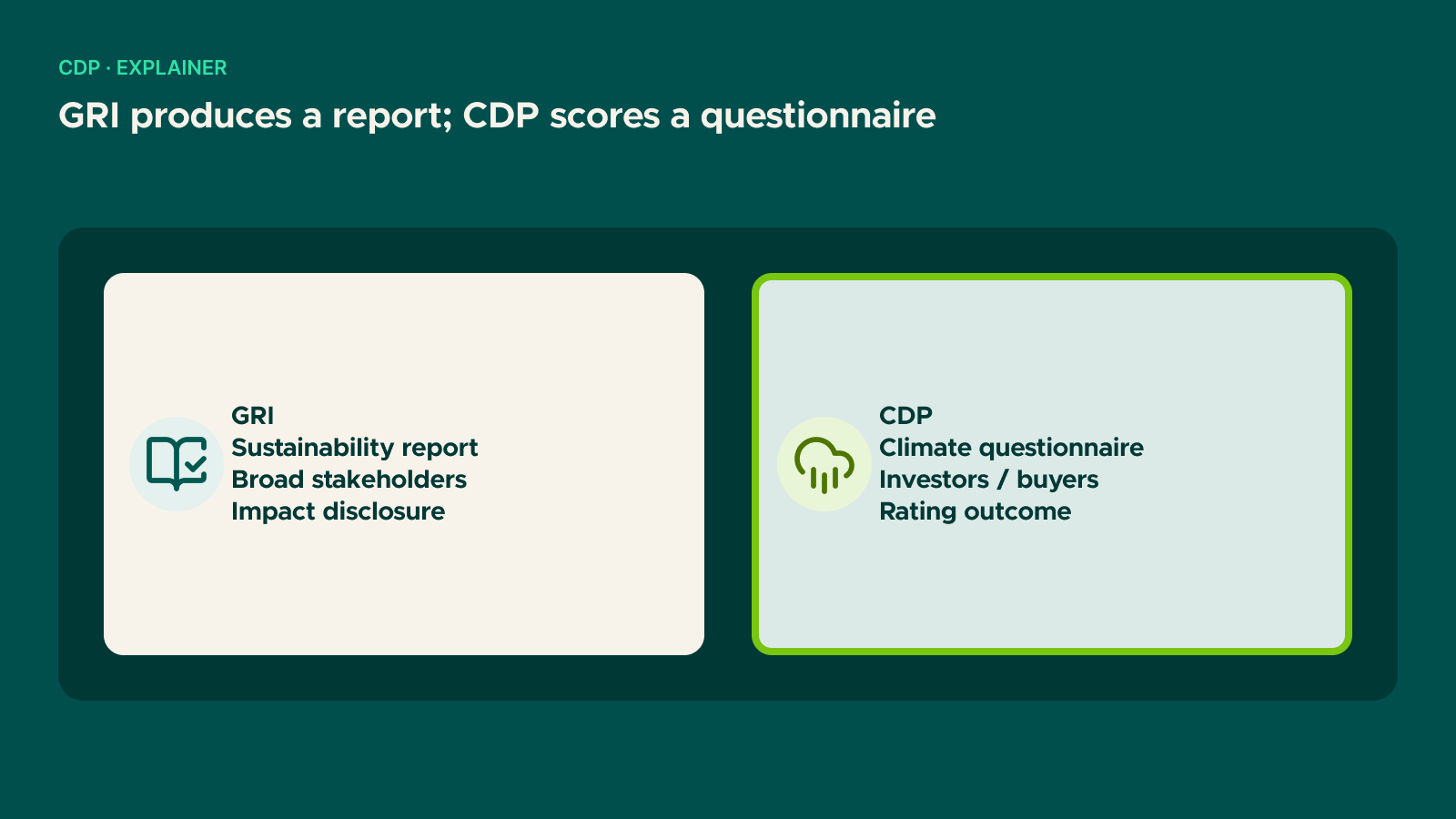
GRI, as described throughout this article series, is a reporting framework rather than a rating system. There is no GRI score or grade — an organization reports its disclosures against the Universal, Sector, and Topic Standards it determines are material (see How Are the GRI Standards Structured?), and the output is a narrative and data-based report, not a comparative rating.
CDP's narrow environmental focus and investor-grade scoring make it valuable for a specific purpose: giving institutional investors a quick, standardized comparison point on climate, water, and forest performance. It does not, however, capture labor practices, community impact, governance disclosures, anti-corruption performance, or the many other topics GRI's Universal and Topic Standards address.
A company that only completes CDP has strong climate-specific investor communication but no broader stakeholder-facing sustainability report. A company that only reports under GRI may lack the specific, benchmarked climate score that certain investors request through CDP's platform. Using both closes this gap: GRI for comprehensive, stakeholder-inclusive reporting, CDP for the specific investor-facing climate, water, and forest rating.
In practice, data collected for GRI Topic Standards on energy and emissions (see the discussion of GRI 102: Climate Change and GRI 103: Energy in How Are the GRI Standards Structured?) substantially overlaps with data CDP's questionnaires request. Companies running both processes typically build a shared data collection workflow feeding both outputs, rather than collecting the same emissions or energy figures twice.
No. A CDP score reflects performance and disclosure quality within CDP's three specific environmental categories. It says nothing about an organization's labor practices, governance, anti-corruption controls, or community relationships — all areas GRI's Universal and Topic Standards cover. Investors requesting CDP disclosure are typically a subset of a company's full stakeholder base; employees, communities, regulators, and customers are better served by the broader GRI report.
CDP, IFRS S1/S2, and ESRS all share an investor-facing orientation, but they are not the same instrument. CDP is a voluntary rating specific to three environmental categories; IFRS S1/S2 and ESRS are broader disclosure standards covering financial or double materiality across sustainability topics generally, with increasing regulatory backing. See GRI vs IFRS S1/S2 for that distinction.
Semtrio Note: Semtrio has been a GRI Community Member since 2020, and works with clients to align GRI Topic Standard data collection — particularly energy and climate-related disclosures — with the data investors request through CDP's separate questionnaire process.
If your organization is running CDP disclosure and GRI reporting as separate, duplicated processes, our sustainability reporting team can help design a shared data workflow that feeds both.
No. CDP and GRI are independent organizations with different mandates — CDP runs a disclosure and rating platform; GRI publishes the GRI Standards, a reporting framework.
No, they are unrelated. GRI reporting does not depend on or feed into a CDP score, and a company can report comprehensively under GRI without ever completing a CDP questionnaire.
GRI is the most widely used sustainability reporting standard globally, with broader thematic scope than CDP, which is more narrowly focused on climate, water, and forests and is generally driven by direct investor requests.
CDP's questionnaires are most commonly triggered by investor or customer requests, but any organization can also disclose independently through CDP's platform.
Get in touch
If something you've read here connects to a live project, a reporting deadline, or a decision you're weighing — we're happy to have a useful conversation.
Contact us
Regulation & Compliance

Regulation & Compliance
Regulation & Compliance
Lets talk about your sustainability goals.