Blog
Publish: 07 Aug 26Reading Time: 4 Min
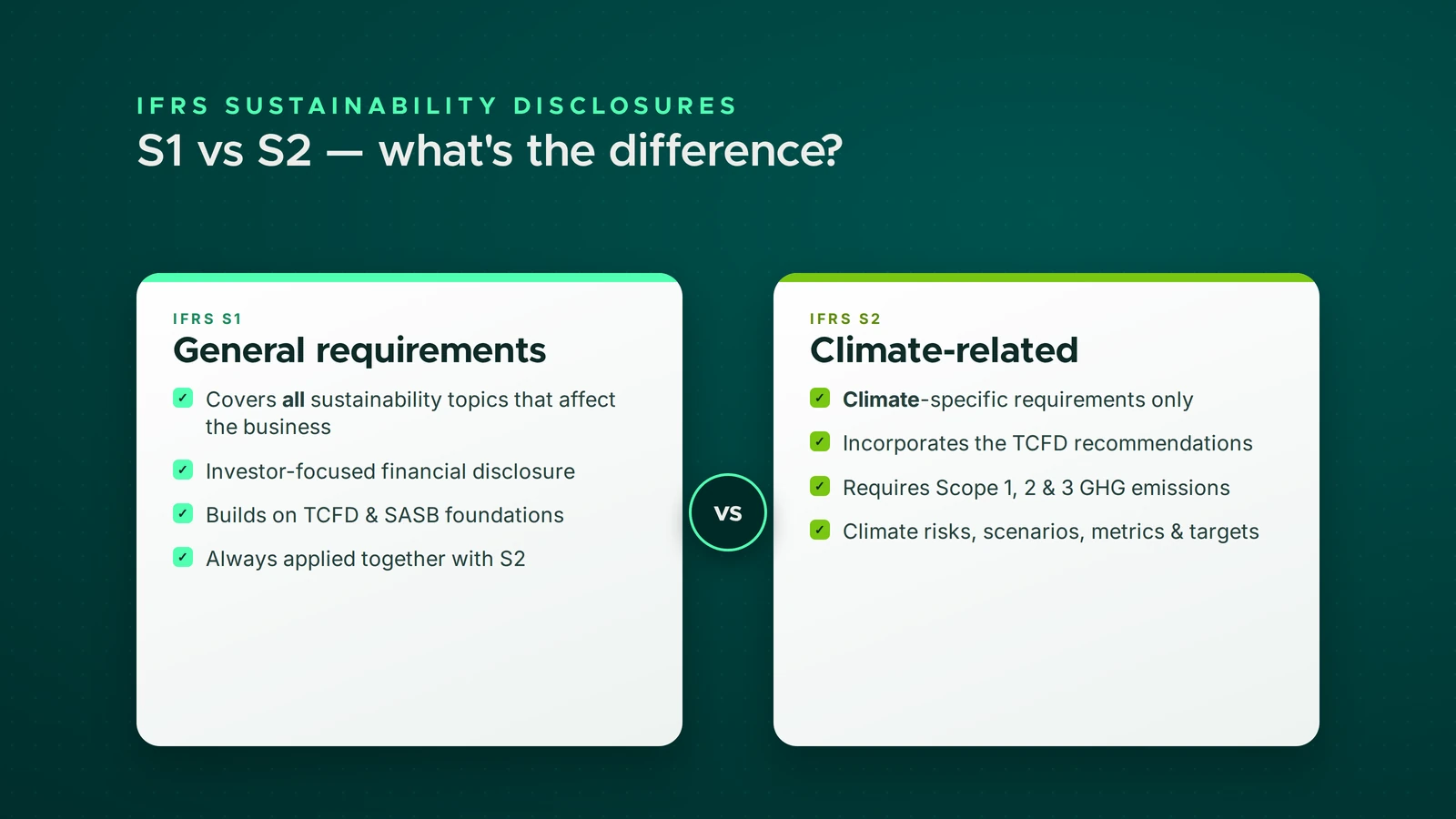
IFRS S1 and IFRS S2 are companion standards issued together by the ISSB, but they serve different purposes: IFRS S1 is the general framework covering all material sustainability-related risks and opportunities, while IFRS S2 is a topic-specific standard that applies that framework exclusively to climate. Neither standard functions fully on its own — companies applying IFRS S2 also apply the general disclosure requirements set out in IFRS S1.
IFRS S1 and IFRS S2 are companion standards issued together by the ISSB, but they serve different purposes: IFRS S1 is the general framework covering all material sustainability-related risks and opportunities, while IFRS S2 is a topic-specific standard that applies that framework exclusively to climate. Neither standard functions fully on its own — companies applying IFRS S2 also apply the general disclosure requirements set out in IFRS S1.
IFRS S1 is topic-agnostic. It establishes the overall requirements for how a company identifies, assesses, and discloses sustainability-related risks and opportunities that are reasonably expected to affect its cash flows, access to finance, or cost of capital. It requires companies to determine materiality themselves, drawing on sources such as the SASB standards for industry-specific guidance where relevant. IFRS S1 also sets requirements that apply across any sustainability topic a company reports on, including:
Connectivity between sustainability disclosures and financial statements
Location of disclosures (alongside general purpose financial reports)
Timing (same reporting period as financial statements)
Use of comparative information and consistent methodologies
IFRS S2 narrows the lens to climate. It requires disclosure of climate-related risks (both physical and transition risks) and opportunities, using the same four-pillar structure as IFRS S1: governance, strategy, risk management, and metrics and targets. IFRS S2 goes further than IFRS S1 in prescribing specific required metrics, including Scope 1, Scope 2, and — where material — Scope 3 GHG emissions, along with climate-related targets and industry-specific metrics drawn from SASB.
A company cannot apply IFRS S2 in isolation. IFRS S1 provides the overarching disclosure architecture — governance oversight, connection to financial statements, materiality judgment process — while IFRS S2 supplies the climate-specific content that populates that architecture. In practice, a company assessing its ISSB obligations will typically apply IFRS S1's general requirements first, then layer in IFRS S2's climate-specific metrics and scenario analysis requirements.
Topic scope: All material sustainability topics / Climate only
Required metrics: Materiality-dependent, company-determined / Scope 1, 2, and (where material) 3 GHG emissions, plus climate KPIs
Scenario analysis: Not specifically required / Required, to test strategy resilience under different climate scenarios
Industry guidance: References SASB standards generally / References SASB climate-related metrics specifically
In practice, most companies applying IFRS sustainability disclosures apply both. A company reporting only under IFRS S2 without also meeting IFRS S1's general requirements would produce climate disclosures without the surrounding governance, connectivity, and materiality framework the ISSB intends.
Understanding the IFRS S1/IFRS S2 split matters operationally. Climate data — emissions inventories, scenario modeling, transition plans — usually requires different systems, data sources, and technical expertise than broader sustainability topics such as workforce metrics or biodiversity. Reporting teams that treat "ISSB compliance" as a single undifferentiated project often underestimate the data architecture work IFRS S2's climate metrics specifically demand. Semtrio's IFRS S1/S2 advisory service is structured around exactly this distinction, treating governance and materiality work under IFRS S1 and climate data/scenario work under IFRS S2 as related but separately scoped workstreams.
Semtrio Note: Semtrio holds CDP Accredited Solutions Provider status, which requires direct, verified proficiency in corporate GHG accounting methodology — the same Scope 1/2/3 measurement discipline that underpins IFRS S2's metrics and targets pillar.
Can a company apply IFRS S2 without applying IFRS S1?
In practice, no. IFRS S2 relies on the general disclosure architecture — governance, connectivity to financial statements, materiality process — set out in IFRS S1, so the two standards are designed to be applied together.
Does IFRS S1 cover climate risk?
IFRS S1 covers all material sustainability-related risks and opportunities in general terms, but the specific climate disclosure requirements — including GHG emissions metrics and scenario analysis — are set out in IFRS S2.
What GHG emissions scopes does IFRS S2 require?
IFRS S2 requires disclosure of Scope 1 and Scope 2 emissions, and Scope 3 emissions where they are material to the company.
Is scenario analysis required under IFRS S1?
No. Scenario analysis to test the resilience of a company's strategy under different climate outcomes is a requirement specific to IFRS S2, not IFRS S1.
Which standard should a reporting team read first?
IFRS S1, since it establishes the general disclosure framework that IFRS S2's climate-specific requirements build on.
If you are unsure whether your organization needs to apply IFRS S1, IFRS S2, or both, Semtrio's advisory team can assess your reporting obligations and scope the work required.
Get in touch
If something you've read here connects to a live project, a reporting deadline, or a decision you're weighing — we're happy to have a useful conversation.
Contact us
Regulation & Compliance
Regulation & Compliance
Regulation & Compliance
Lets talk about your sustainability goals.