Blog
Publish: 10 Nov 26Reading Time: 7 Min
The EU Emissions Trading System (EU ETS) is the EU's cap-and-trade carbon market: power and heat producers, industrial installations, aviation and, since 2024, maritime transport must hold and surrender allowances for their emissions, under a cap tightened to cut emissions 62% by 2030 compared with 2005. A company producing outside the EU has no EU ETS obligation for its own plant. Since 1 January 2026, however, the EU ETS price reaches its goods through CBAM, the carbon charge on imported iron and steel, aluminium, cement, fertilisers, hydrogen and electricity.
Updated 10 November 2026.
Set up in 2005, the EU ETS is the world's first international emissions trading system. It operates in all EU countries plus Iceland, Liechtenstein and Norway, is linked to the Swiss ETS, and covers about 40% of the EU's total greenhouse gas emissions.
The mechanism has three parts:
For a Turkish company, shipping is the part that can create a direct EU ETS obligation: the Commission describes the maritime ETS as flag-neutral and route-based, so coverage follows the voyage, not where the operator is based. For manufacturers, the exposure comes through CBAM.
Free allocation exists to protect EU producers from carbon leakage. CBAM replaces that protection in its sectors: as free allowances for iron and steel, aluminium, cement, fertilisers and hydrogen are phased out between 2026 and 2034, CBAM charges importers for a growing share of embedded emissions. In 2026 producers in CBAM sectors keep 97.5% of their benchmark-based free allocation; under current law it reaches zero in 2034.
That timeline may move. On 17 July 2026 the Commission proposed an EU ETS revision that would reintroduce 15% of the phased-out free allocation in CBAM sectors from 2028, stretching the phase-out to 2038. It is a proposal under negotiation, not law.
CBAM is built as the mirror of the EU ETS, and three links connect them:
The difference between the two systems, item by item: CBAM vs EU ETS: what is the difference. The CBAM basics in one page: What is CBAM?
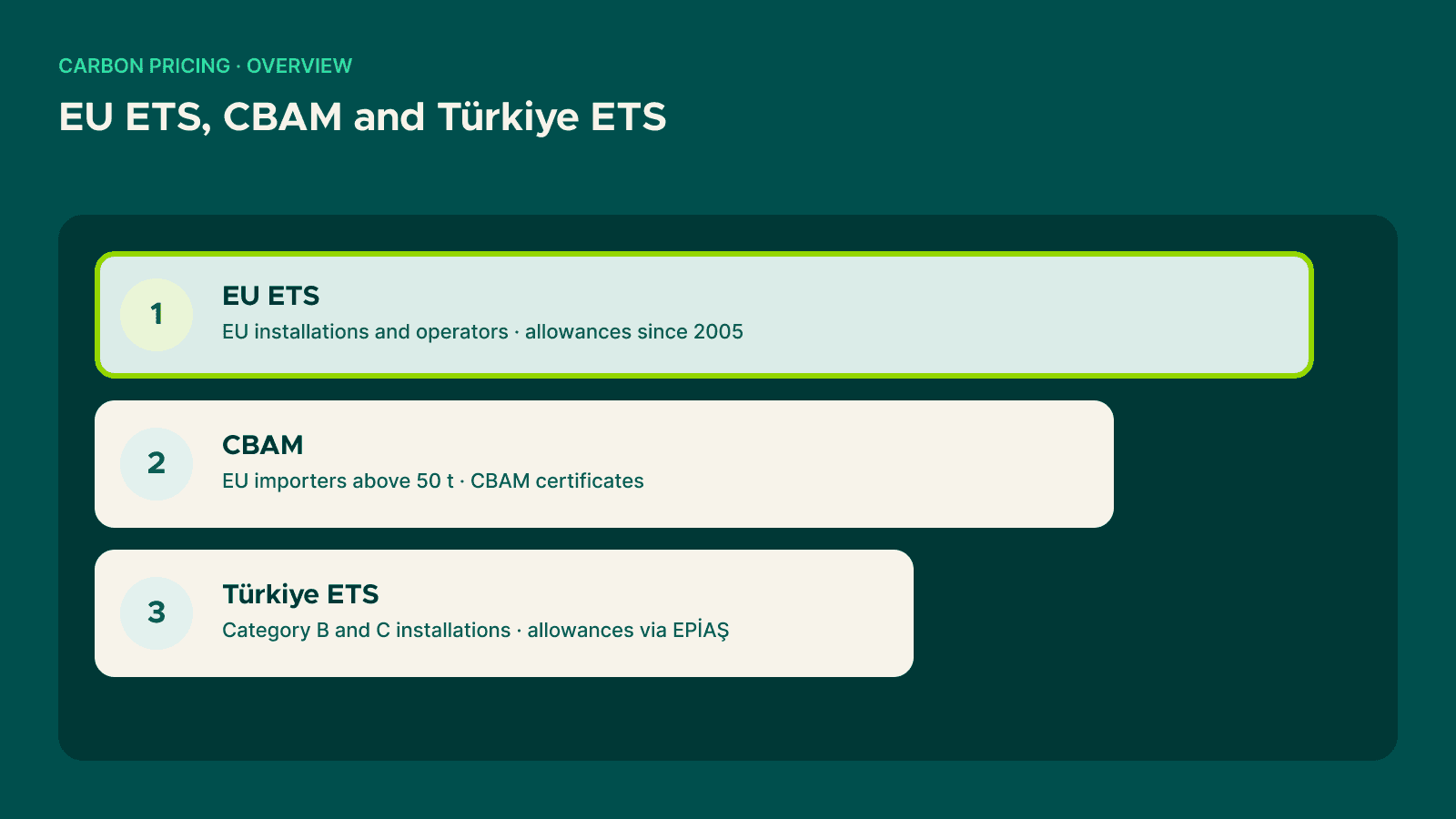
| EU ETS | CBAM | Türkiye ETS | |
|---|---|---|---|
| Legal basis | Directive 2003/87/EC, as revised | Regulation (EU) 2023/956, amended by Regulation (EU) 2025/2083 | Climate Law No. 7552 (Resmî Gazete, 9 July 2025, No. 32951), Article 9; Türkiye ETS Regulation (Resmî Gazete, 27 August 2026, No. 33353) |
| Who is obliged | Installations in the EU, Iceland, Liechtenstein and Norway; aircraft and ship operators for covered flights and voyages | EU importers (authorised CBAM declarants) above 50 tonnes a year; electricity and hydrogen always | Category B (over 50,000 up to 500,000 t CO2e a year) and Category C (over 500,000 t CO2e) installations in Türkiye |
| What is priced | Emissions of covered installations and operators | Emissions embedded in imported CBAM goods | Emissions of covered installations |
| Instrument | Tradable allowances | CBAM certificates, not tradable or transferable | Allowances, traded on a market operated by EPİAŞ |
| Free allocation | Yes, phased out in CBAM sectors 2026–2034 | Mirrored through the free allocation adjustment | Yes, set by the Carbon Market Board using benchmarks |
| Annual cycle | Verified emissions report and surrender each year | Declaration and surrender by 30 September of the following year | Verified emissions report by 30 April; surrender by the last business day of November |
| Status | In force since 2005 | Definitive period since 1 January 2026 | Starts with a pilot period whose scope and duration the Carbon Market Board sets |
The European Climate Law sets the binding targets behind the European Green Deal: a net greenhouse gas reduction of at least 55% by 2030 and 90% by 2040, both against 1990, and climate neutrality by 2050. The 2040 target was added by Regulation (EU) 2026/667. The EU ETS is the EU's main carbon-pricing tool for reaching them, and the Commission's July 2026 revision proposal is designed to align the system with the 2040 target.
For Turkish industrial groups, the EU ETS mostly arrives as CBAM data work. With Tosyalı Holding, that meant embedded emissions quantified from production-level data and quarterly submission packages prepared for each of about 20 production entities, with every calculation technically reviewed before it reached facility teams. How we run that cycle: CBAM accounting and reporting.
Not to their plants. The EU ETS covers installations in the EU, Iceland, Liechtenstein and Norway. Non-EU shipping operators are covered for voyages to, from and between EU ports, and non-EU manufacturers feel the ETS price through CBAM on their exports.
No. Türkiye has its own emissions trading system, based on Climate Law No. 7552 and the Türkiye ETS Regulation published on 27 August 2026. It covers Category B and C installations and starts with a pilot period.
Emissions monitoring and reporting for ETS2 started in 2025. The Commission states that the system becomes fully operational in 2028, covering fuel combustion in buildings, road transport and additional sectors.
No. CBAM certificates are priced from EU ETS auction prices, but they can only be used by the authorised declarant that bought them, cannot be traded or transferred, and are either surrendered, repurchased or cancelled.
Under current law, yes: free allocation in CBAM sectors falls from 2026 and reaches zero in 2034. A Commission proposal of 17 July 2026 would stretch this to 2038; it is still under negotiation.
Book a scoping call and get a carbon-price exposure map for your sites: which installations fall into Türkiye ETS Category B or C, which CN codes reach EU customers under CBAM, and where verified data would replace default values → CBAM accounting and reporting.
Get in touch
If something you've read here connects to a live project, a reporting deadline, or a decision you're weighing — we're happy to have a useful conversation.
Contact usLets talk about your sustainability goals.


