Blog
Publish: 10 Nov 26Reading Time: 8 Min
GRI 102: Climate Change 2025 and GRI 103: Energy 2025 are GRI's revised Topic Standards for climate and energy, published in June 2025. They are required for reporting published on or after 1 January 2027: GRI 102 replaces Disclosures 305-1 to 305-5 and 201-2, and GRI 103 replaces GRI 302: Energy 2016. A GRI report published in 2027 on the 2026 year therefore needs data that fits the new disclosures, which means the 2026 data cycle is already the first one affected.
They are the second and third GRI Topic Standards released since GRI's 2021 restructuring, which is why they carry new numbers instead of the old 300-series. Both were developed by multi-stakeholder Technical Committees under the Global Sustainability Standards Board (GSSB) and were built together, so the energy figures in GRI 103 feed the emissions figures in GRI 102.
The scope moves beyond emissions counting. GRI says the climate revision was meant to cover transition and adaptation strategies, progress on reduction targets and transparency on carbon credits, in addition to emissions.
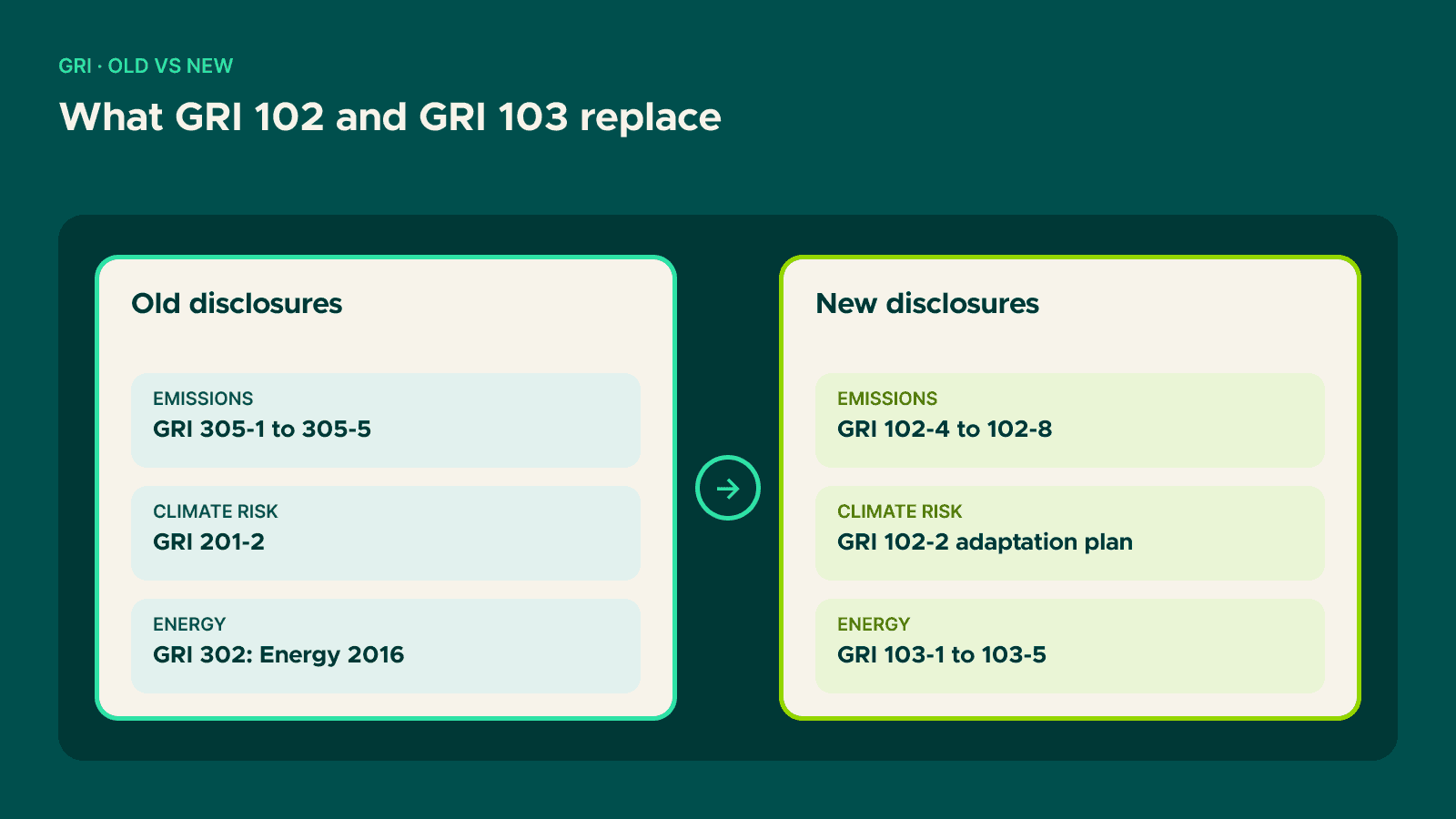
| Old standard | New standard | |
|---|---|---|
| Climate | GRI 305: Emissions 2016, Disclosures 305-1 to 305-5; GRI 201: Economic Performance 2016, Disclosure 201-2 | GRI 102: Climate Change 2025, Disclosures 102-1 to 102-10 |
| Energy | GRI 302: Energy 2016 | GRI 103: Energy 2025, Disclosures 103-1 to 103-5 |
| Effective | – | Reporting published on or after 1 January 2027; earlier adoption encouraged |
| Still in use | GRI 305 Disclosures 305-6 and 305-7 | Not replaced by GRI 102 |
The last row matters for your content index: after 2027, a report can cite GRI 102 for greenhouse gases and still cite GRI 305 for 305-6 and 305-7.
GRI 102 has ten disclosures. The first three are new territory for most GRI reporters:
There is no minimum number of disclosures. Under GRI 1, an organisation that finds climate change material reports Disclosure 3-3 plus the GRI 102 disclosures relevant to its impacts, and reasons for omission are permitted for all ten.
GRI 103 has five disclosures, 103-1 to 103-5. GRI lists these main changes:
If you can't split purchased electricity into renewable and non-renewable, GRI 103 requires a reason for omission with an explanation.
IFRS S2. GRI and the IFRS Foundation have published a joint statement on using GRI 102 and IFRS S2 together. It includes confirmation from the GSSB and ISSB that equivalent IFRS S2 disclosures on Scope 1, 2 and 3 GHG emissions can be used to meet the corresponding GRI 102 requirements. The two still serve different purposes: IFRS S2 asks about climate-related risks and opportunities for investors, while GRI 102 asks about the organisation's impacts on climate and people. A transition plan written for one won't automatically cover the other.
ESRS E1. GRI and EFRAG experts worked together during development. An ESRS–GRI interoperability index shows how ESRS disclosures can respond to GRI requirements. GRI noted that its ESRS–GRI data point mapping still referred to GRI 305 and 201 when GRI 102 was released and would be updated to GRI 102.
For the background on the two frameworks, see GRI vs IFRS S1 and S2 and GRI vs ESRS.
Yes. GRI 11 (Oil and Gas), GRI 12 (Coal), GRI 13 (Agriculture, Aquaculture and Fishing) and GRI 14 (Mining) are being aligned with GRI 102 and GRI 103. GRI said the updated reporting sections would be available from 1 January 2026 and become mandatory when GRI 102 and GRI 103 take effect. If a Sector Standard applies to you, check its updated climate and energy section, not the 2021–2024 original. More in our GRI Sector Standards 2026 update.
The work that takes longest is rarely the emissions figure; it's the data that sits with other teams, such as energy source splits, HR metrics and carbon credit records. Designing one KPI set that serves GRI, IFRS S2, CDP and EcoVadis at the same time avoids collecting the same numbers twice. That is how our GRI reporting service is structured, with IFRS S2 data mapping as one of its extension outputs. At Turkish Technic, one data collection fed both the GRI disclosures and the EcoVadis evidence base. For the IFRS S2 side, see our IFRS S1 and S2 advisory.
On 1 January 2027. GRI requires them for all climate and energy reporting published on or after that date, and encourages earlier adoption.
No. GRI 102 replaces Disclosures 305-1 to 305-5 and Disclosure 201-2. Disclosures 305-6 and 305-7 remain in GRI 305.
No. There is no minimum number; you report the disclosures relevant to your climate-related impacts, plus Disclosure 3-3. Reasons for omission are permitted for every GRI 102 disclosure.
Yes, for Scope 1, 2 and 3. The GSSB and ISSB confirmed in a joint statement that equivalent IFRS S2 emissions disclosures can meet the corresponding GRI 102 requirements.
No. GRI 102 and GRI 103 are Topic Standards that any organisation can use. The Sector Standards for oil and gas, coal, agriculture and mining are being updated to point to them.
GRI 102 refers to the GHG Protocol Corporate Standard (2004) for measuring emissions and uses the Scope 3 categories of the Corporate Value Chain (Scope 3) Standard (2011).
Book a scoping call and leave with a list of the GRI 102 and GRI 103 data points your 2026 data collection doesn't cover yet.
Get in touch
If something you've read here connects to a live project, a reporting deadline, or a decision you're weighing — we're happy to have a useful conversation.
Contact usLets talk about your sustainability goals.