Blog
Publish: 10 Nov 26Reading Time: 8 Min
Paragraph 22 of IFRS S2 requires a company to disclose how resilient its strategy and business model are to climate change, and to use climate-related scenario analysis to assess that resilience "using an approach that is commensurate with the entity's circumstances" (application guidance in paragraphs B1–B18). IFRS S2 does not prescribe which scenarios to use, but you must disclose which scenarios you chose and why, their sources, the time horizons and key assumptions, and when the analysis was carried out. You assess resilience every year; the scenario analysis itself must be updated at least in line with your strategic planning cycle.
Paragraph 22 has two parts.
22(a): your assessment of climate resilience. You disclose the implications for your strategy and business model, the significant areas of uncertainty you considered, and your capacity to adjust or adapt over the short, medium and long term. That capacity covers the flexibility of your financial resources, your ability to redeploy, repurpose, upgrade or decommission assets, and the effect of current and planned climate investments.
22(b): how and when the scenario analysis was carried out. IFRS S2 lists the information expected:
| Disclosure under 22(b) | What it means for your team |
|---|---|
| Which scenarios you used and their sources | Name the scenario family and edition, for example "IEA WEO 2025, STEPS" |
| Whether you used a diverse range of scenarios | One scenario is not a range |
| Whether scenarios relate to transition risks, physical risks or both | Physical and transition analysis often need different inputs |
| Whether one scenario is aligned with the latest international agreement on climate change | IFRS S2 does not hard-code the Paris Agreement or a 1.5°C scenario, but you must say whether you included one |
| Why the chosen scenarios are relevant | Tie each scenario to your markets, assets or supply chain |
| Time horizons and scope of operations | For example 2030, 2040 and 2050; which sites and business units |
| Key assumptions | Climate policies where you operate, macroeconomic trends, national or regional variables, energy use and mix, technology |
| The reporting period in which the analysis was done | You can rely on an analysis from a prior period if it follows your planning cycle |
In providing quantitative information, you may disclose a single amount or a range.
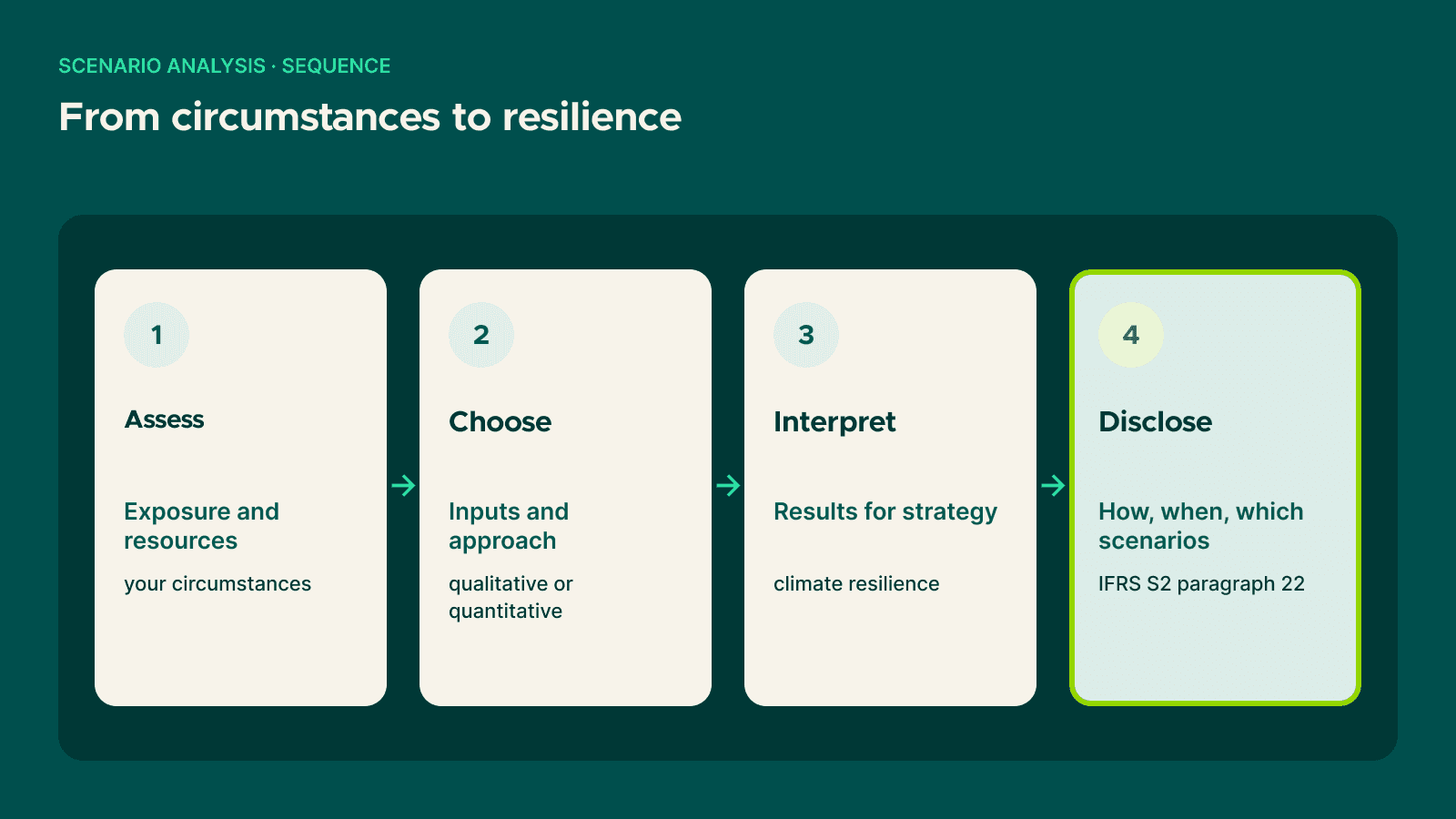
This is the proportionality test in paragraphs B2–B7. You assess two things:
Paragraphs B8–B15 add a second test: your approach must let you consider all reasonable and supportable information available at the reporting date without undue cost or effort. That applies both to the inputs you select (scenarios, variables) and to your analytical choice (qualitative or quantitative).
The IFRS Foundation's educational material illustrates the logic with two companies. A large energy company with high regulatory exposure and in-house modelling capacity uses four scenarios with both qualitative narratives and quantitative modelling. A mid-sized consumer goods company doing scenario analysis for the first time uses three scenarios and qualitative narratives only. Both approaches can meet the standard.
| Qualitative analysis | Quantitative analysis | |
|---|---|---|
| What it produces | Scenario narratives: how each future would affect demand, costs, assets and supply chain | Modelled values: carbon cost, revenue at risk, asset damage, capex needs |
| Typical inputs | Published scenario storylines, expert workshops, risk register | Scenario variables such as carbon prices, energy mix and temperature, linked to your financial model |
| When it is commensurate | Lower exposure, first-time analysis, limited modelling resources | High exposure, scenario analysis established in your industry, resources in place |
| Watch out for | Narratives with no link to the business model | False precision from untested assumptions |
The IFRS Foundation notes that quantitative information will often enable a more robust assessment, but that qualitative information, alone or with quantitative data, can also provide a reasonable and supportable basis. The educational material also expects approaches to evolve over time, so a qualitative first cycle can be followed by quantifying the most material risks in later cycles.
IFRS S2 leaves the choice to you, as long as the scenarios are relevant and you can support them. Three public families cover most needs:
Name the edition you used. "IEA scenarios" without a year leaves an assurance provider, or an investor, unable to trace your inputs.
At Borçelik, the IFRS S2-aligned disclosure used two transition and two physical climate scenarios, each tested against focal questions agreed with the company's team, before targets were benchmarked and the disclosure drafted. At Netaş, a verified Scope 1–2 inventory came first and became the base for the climate-risk scenario work. In both cases, the scenario analysis was only as defensible as the data and the governance sessions behind it. For the full disclosure set, see what IFRS S1 and S2 require and the IFRS S1/S2 reporting checklist.
Yes, wherever IFRS S2 (or TSRS 2) applies to you. Paragraph 22 requires a company to use climate-related scenario analysis to assess its climate resilience. What is flexible is the approach: it must be commensurate with your circumstances, from qualitative narratives to quantitative modelling.
No specific scenario is required. You must disclose whether your analysis included a scenario aligned with the latest international agreement on climate change. If it did not, investors will see that in your disclosure.
At least in line with your strategic planning cycle; the IFRS Foundation gives every three to five years as an example. The climate resilience assessment itself is done every reporting year, using the most recent scenario analysis.
Yes, if that approach is commensurate with your exposure and resources and lets you consider all reasonable and supportable information without undue cost or effort. The IFRS Foundation's own illustration shows a mid-sized company using qualitative narratives only.
IFRS S2, and TSRS 2 based on it, do not prescribe scenarios. Pick scenarios relevant to your exposure: for example, IEA or NGFS transition scenarios for carbon pricing and energy costs, and IPCC-based physical projections for your sites. Record the edition and the reason for each choice.
IFRS S2 requires scenario analysis only for the climate resilience assessment. The IFRS Foundation notes it can also help when you identify climate-related risks and opportunities and when you disclose anticipated financial effects, so one well-documented analysis can serve several sections.
Get a scenario analysis plan for your first IFRS S2 or TSRS report: proportionality rationale, scenario set and focal questions, agreed in a scoping call. IFRS S1/S2 advisory.
Get in touch
If something you've read here connects to a live project, a reporting deadline, or a decision you're weighing — we're happy to have a useful conversation.
Contact usLets talk about your sustainability goals.