Blog
Publish: 17 Sep 26Reading Time: 4 Min
Fertilisers carry the most distinctive rule set of the four industrial sectors in CBAM scope. The functional unit is defined on nitrate content, indirect emissions are counted, and most significantly the mark-up added to default values is fixed at 1% rather than the 10% to 30% applied elsewhere. That exception makes the sector's CBAM strategy different from the others.
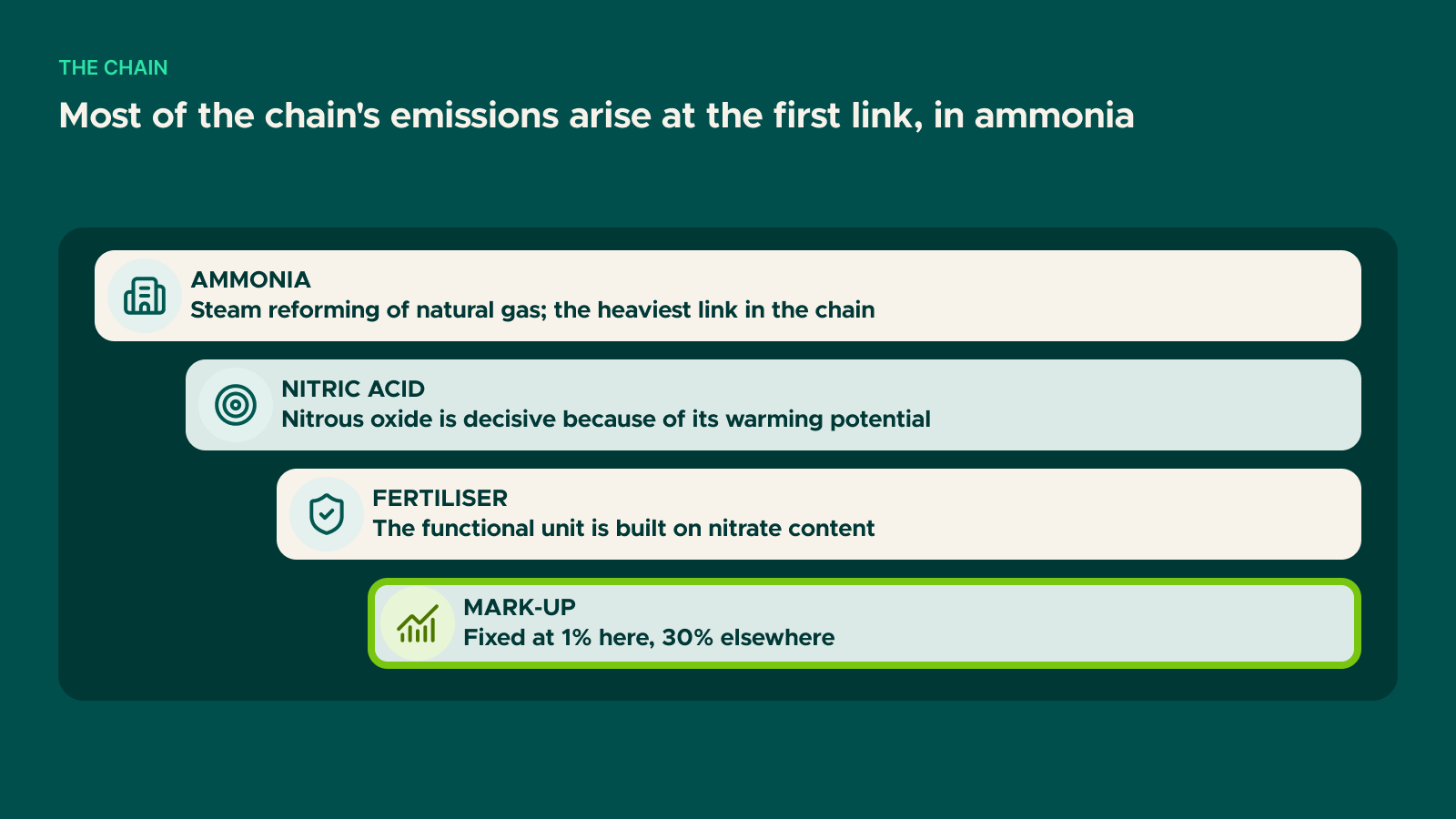
The nitrogen fertiliser chain has three links, and CBAM scope touches each of them.
Ammonia is the start of the chain, produced by steam reforming of natural gas. Gas serves as both feedstock and fuel, so ammonia's emissions intensity tracks gas consumption directly. Most of the chain's emissions arise at this link.
Nitric acid is produced by oxidising ammonia. The process releases nitrous oxide (N₂O), whose global warming potential is hundreds of times that of carbon dioxide, making it a decisive line in the emissions calculation even at small mass.
Fertiliser is ammonium nitrate and its derivatives, and compound products, made from nitric acid and ammonia.
Scope covers all three links: nitric acid and sulphonitric acids (CN 2808), ammonia (CN 2814), potassium nitrate, nitrogenous fertilisers (CN 3102) and compound fertilisers containing two or three nutrients (CN 3105).
Nitrous oxide emissions in nitric acid plants can be reduced substantially with catalytic decomposition systems. These technologies are comparatively mature and the capital requirement is modest against the abatement they deliver.
Their significance under CBAM is specific: because of N₂O's high global warming potential, a small reduction in mass terms translates into a large reduction in CO2-equivalent terms. The cost of reducing emissions intensity in fertilisers is therefore markedly lower than in cement or steel, where the constraints are structural.
The measurement side is more demanding. Monitoring N₂O with continuous emission measurement systems is what meets the evidentiary standard sought in verification; declarations resting on periodic measurement carry a wider uncertainty band.
In other sectors embedded emissions are expressed per tonne of product. In fertilisers the calculation is built on nitrate content. The practical consequence is that two products of identical weight but different nutrient content carry different embedded emissions.
That matters for portfolio management. Low-nutrient products may show low emissions per unit weight while looking quite different once the calculation is done per unit of nitrate. The calculation therefore has to be built at recipe level, with nutrient content evidenced by analysis.
Where default values are used, a mark-up is added: 10% in 2026, 20% in 2027 and 30% from 2028 in other sectors. In fertilisers it is fixed at 1%, an exception settled during the Omnibus negotiations on food security grounds.
The economic consequence is direct: there is almost no penalty for using default values in fertilisers. In other sectors the strongest argument for producing actual data is avoiding the mark-up; in fertilisers that argument largely disappears.
The decision then reduces to a single question: how far below the country default value does the installation sit? Where the gap is meaningful, actual data still pays; where it is narrow, verification cost can exceed the benefit. We set out the decision framework in default values and country mark-ups.
Fertilisers are one of the three product groups where indirect emissions count. Electricity consumption varies by process configuration and is added to the calculation.
The sector's larger exposure, however, is not electricity but natural gas. Because gas is simultaneously feedstock and energy source, gas price and emissions intensity shape the cost structure at the same time. That places fertilisers at a particular intersection under CBAM: carbon cost and energy cost move in the same direction rather than offsetting one another.
For plants buying ammonia and producing fertiliser, most of the figure is determined by the supplier's data. Ammonia's embedded emissions vary across a wide range depending on production route and gas efficiency.
Where verified supplier data is unavailable, a default value applies. Even with the 1% mark-up, that default is a country average — so the advantage of buying from a low-emission supplier becomes invisible. Writing the precursor data requirement into supply contracts is therefore necessary regardless of the mark-up exception.
The wider calculation method is set out in calculating CBAM embedded emissions.
The cost difference is small because of the 1% mark-up. But if your installation performs meaningfully below the country average, only actual data will show it.
Payback is the CO2 equivalent avoided multiplied by the certificate price, scaled by EU-bound volume. Because of N₂O's high warming potential, the return per unit abated is high.
On nitrate content. The product recipe and nutrient analysis are the basis of the calculation.
No. Fertilisers are one of the three groups where indirect emissions are counted.
We work on building product-level emissions calculations for ammonia, nitric acid and fertilisers, under our CBAM accounting and reporting service. You can contact us with your questions.
Get in touch
If something you've read here connects to a live project, a reporting deadline, or a decision you're weighing — we're happy to have a useful conversation.
Contact us
Regulation & Compliance
Regulation & Compliance
Regulation & Compliance
Lets talk about your sustainability goals.