Blog
Publish: 16 Nov 26Reading Time: 7 Min
Carbon neutral and net zero are different claims. Under ISO 14068:2026, a company or product is carbon neutral for a stated period when its footprint has been reduced and the remainder offset with carbon credits. Under the SBTi Corporate Net-Zero Standard, a company reaches net zero only when it has cut Scope 1, 2 and 3 emissions to residual levels and neutralises those residuals with carbon removals. In the EU, product claims of a neutral climate impact that rely on offsetting are banned in consumer marketing under national rules that apply from 27 September 2026.
ISO itself draws the line. The introduction to ISO 14068:2026 says carbon neutrality for organisations and products commonly involves offsetting to counterbalance a footprint. For organisations, net zero is commonly understood as the condition in which emissions have been reduced so that only residual emissions remain, with offsetting restricted to removal credits. ISO 14068 does not set requirements for net zero, and ISO notes that net zero is defined and assessed differently in different contexts. For companies, this article uses the SBTi Corporate Net-Zero Standard as the reference.
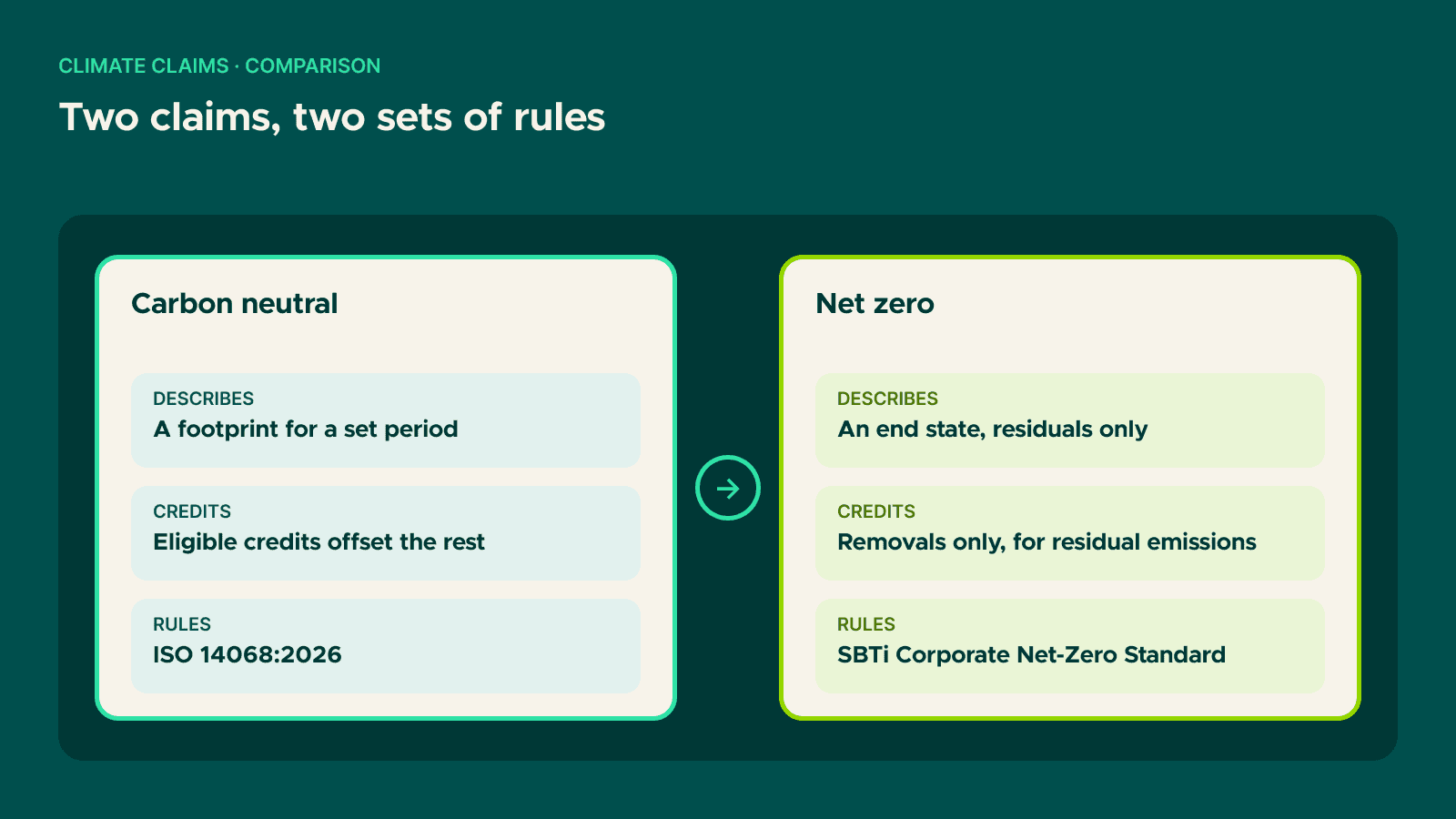
| Carbon neutral | Net zero | |
|---|---|---|
| What it describes | A footprint over a stated period, counterbalanced by offsetting after reductions | An end state: emissions cut to zero or residual levels, then neutralised |
| Role of carbon credits | Eligible credits offset the footprint that remains after reductions | Only carbon removals count, and only for residual emissions |
| Reference used here | ISO 14068:2026, for organisations and products | SBTi Corporate Net-Zero Standard, for companies |
| Time frame | A finite number of years for an organisation, or a life cycle for a product | A net-zero target year of 2050 at the latest |
In practice, a company can be carbon neutral for 2025 and still be decades from net zero. The two claims answer different questions: what did you do about last year's footprint, and where will your emissions end up?
ISO 14068:2026 replaced ISO 14068-1:2023 in 2026. ISO describes the change as a minor revision: the title was updated and the part number removed.
The standard covers organisations, including companies and financial institutions, and products, including buildings and events. It does not cover territories. Its core rule is a hierarchy: emission reductions and removal enhancements within the value chain come before offsetting. A carbon neutrality claim built on it needs:
ISO 14068 is programme neutral, so any GHG programme you use adds its own requirements on top. To judge the credits themselves, see our guide to the voluntary carbon market and carbon credit quality.
The SBTi published Version 2.0 of its Corporate Net-Zero Standard on 11 June 2026. Companies can book validation slots under V2.0 from 1 February 2027. Version 1.3 stays open for target submissions until 31 January 2028, so between those dates companies can choose either version. Our SBTi explainer covers the criteria in full. For the claim question, three provisions of V2.0 matter.
Net zero is a condition you reach, not one you buy. To reach net zero, a company must reduce Scope 1, 2 and 3 emissions to zero or to a residual level consistent with eligible net-zero pathways. It must then neutralise residual emissions at the net-zero target date and every year after that.
Only removals neutralise. Residual emissions must be neutralised with eligible carbon removals. Residuals of long-lived greenhouse gases need long-lived removals. Long-term targets aim for residual emission levels by 2050 at the latest.
Credits complement reductions; they do not replace them. V2.0 treats high-integrity carbon credits as "a complement and not a substitute" for cutting your own footprint, through a voluntary recognition programme for ongoing emissions responsibility. The SBTi intends that, after 2035, Category A companies will be required to support eligible carbon removals; those criteria are illustrative and will be reviewed in the next major revision. Removals bought because a target was missed are not counted toward target progress.
Until your inventory reaches its residual level, the accurate claim is a target, such as "we have a net-zero target validated by the SBTi", not "we are net zero". The SBTi said it expected to publish a Claims Policy in Q4 2026. It had not been published when we checked on 16 November 2026.
Directive (EU) 2024/825 on empowering consumers for the green transition required Member States to adopt national measures by 27 March 2026 and to apply them from 27 September 2026. Two of its rules decide how these claims can be used in consumer marketing:
The Directive does not stop you from talking about credits. Its recital 12 says companies can still advertise their investments in environmental initiatives, including carbon credit projects, as long as the information is not misleading. The proposed Green Claims Directive, which would have added detailed substantiation and verification rules, is not law. The Commission's 2027 work programme of 4 November 2026 lists it among the proposals it intends to withdraw. The full picture is in EU greenwashing rules in 2026.
| Your situation | A claim you can support | What it needs |
|---|---|---|
| Targets validated, reductions under way | "Our net-zero target is validated by the SBTi" | An SBTi target validation |
| Footprint reduced and the remainder offset for a past period | A carbon neutrality claim for that stated period, made under ISO 14068 | The standard's requirements, including a management plan, a quantified footprint, eligible credits, a carbon neutrality report and its rules on claims; never an offset-based product claim to EU consumers |
| Long-term ambition | "We aim to reach net zero by [year]" | A detailed implementation plan with measurable, time-bound targets; in EU consumer marketing, regular verification by an independent expert |
"We are net zero" belongs only to a company whose Scope 1, 2 and 3 emissions are at residual levels and neutralised with removals, every year from the net-zero target date.
The weakest point of most climate claims is not the target but the sentence written about it. A target sits in a validation record, while the claim sits on packaging, a tender form or a sales deck where nobody checked it against the standard. The companies that avoid trouble keep one approved wording per claim and tie each to its evidence: the validation letter, the neutrality report or the implementation plan. SBTi advisory covers both the target and the claim wording, starting from your corporate GHG inventory.
No. Carbon neutral describes a footprint over a set period that has been reduced and then offset with eligible credits under ISO 14068. Net zero, under the SBTi, means cutting Scope 1, 2 and 3 emissions to residual levels and neutralising the rest with carbon removals.
Not as a substitute for cutting emissions. Under V2.0, eligible carbon removals neutralise residual emissions from the net-zero year, and high-integrity credits can earn recognition for ongoing emissions responsibility as a complement to reductions.
It was replaced in 2026 by ISO 14068:2026. ISO calls the new edition a minor revision in which the title changed and the part number was removed, so references to the 2023 edition should now cite ISO 14068:2026.
Not about a product in consumer marketing if the claim relies on offsetting; national rules transposing Directive (EU) 2024/825 ban that from 27 September 2026. You can still describe your investment in carbon credit projects, provided the description is not misleading.
Companies can book V2.0 validation slots from 1 February 2027. Between then and 31 January 2028, when Version 1.3 closes to target submissions, companies can choose either version; after that, submissions move to V2.0.
The SBTi validates targets. It said it would publish a Claims Policy in Q4 2026 setting the conditions for claims about validated targets and progress; it had not been published as of 16 November 2026. Until then, companies remain responsible for making sure their claims are accurate and substantiated.
Book an SBTi scoping call and leave with a gap list of your inventory against the V2.0 net-zero criteria and a wording check of the climate claims you use today: SBTi advisory.
Get in touch
If something you've read here connects to a live project, a reporting deadline, or a decision you're weighing — we're happy to have a useful conversation.
Contact usLets talk about your sustainability goals.


