Blog
Publish: 10 Nov 26Reading Time: 7 Min
The Science Based Targets initiative (SBTi) publishes the criteria a company's emissions-reduction targets must meet to count as aligned with limiting warming to 1.5°C, and it validates targets against those criteria. Today, near-term targets are validated under the Corporate Near-Term Criteria V5.3.1 and net-zero targets under the Corporate Net-Zero Standard V1.3.1. The new Corporate Net-Zero Standard V2.0, published on 11 June 2026, can be used from 1 February 2027 and becomes mandatory for all new submissions from 1 February 2028.
Most companies meet the SBTi through a request: a customer's supplier programme, a lender's sustainability-linked loan, or a CDP question. Knowing which rulebook applies, and what it asks of your inventory, decides how much work the target takes.
The answer starts with your greenhouse gas inventory, not with the ambition of the target. Under the near-term criteria in force today (V5.3.1, effective 14 April 2026), a target has to pass these checks:
| Check | What the V5.3.1 criteria require |
|---|---|
| Scope 1 and 2 coverage | Targets cover at least 95% of company-wide Scope 1 and 2 emissions |
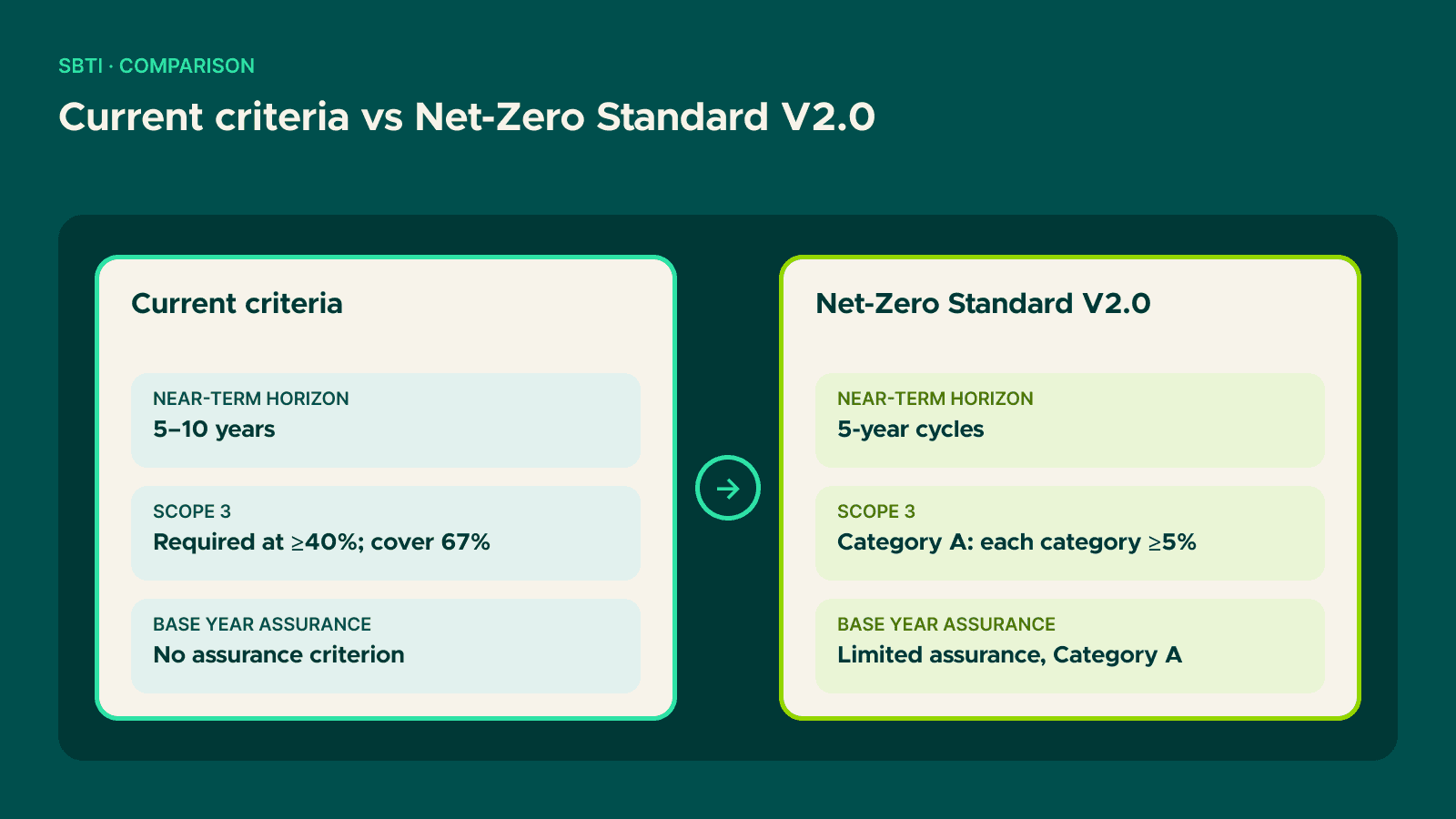
| Scope 3 trigger | If relevant Scope 3 emissions are 40% or more of total Scope 1, 2 and 3 emissions, Scope 3 must be in the near-term target |
| Scope 3 coverage | Near-term Scope 3 targets (reduction and/or supplier or customer engagement) collectively cover at least 67% of Scope 3 emissions |
| Timeframe | 5 to 10 years from the date the target is submitted for validation |
| Base year | No earlier than 2015; Scope 1 and 2 targets use the same base year |
| Carbon credits | Not counted as emission reductions toward the target |
| Reporting | The company-wide inventory and progress against targets are reported publicly every year |
The practical consequence is in the second row. A company that has never screened its Scope 3 emissions cannot know whether the 40% trigger applies, so it cannot know how large its target boundary has to be. That is why a target project usually opens with an inventory review, and why our corporate GHG accounting work and SBTi work are often the same engagement.
V2.0 is a full revision of the Corporate Net-Zero Standard. It sets the rules for near-term and net-zero targets in one standard, and it changes who has to do what.
The timeline:
What changes for companies:
The choice depends on when you plan to submit, and the 11-month overlap gives you one decision to make early.
| If you plan to submit… | Rulebook | What to build first |
|---|---|---|
| Before 1 February 2027 | V5.3.1 near-term (+ V1.3.1 net-zero) | Scope 3 screening against the 40% trigger and 67% coverage |
| Between 1 February 2027 and 31 January 2028 | Your choice: current criteria or V2.0 | A category check (A or B) and a comparison of both boundaries |
| From 1 February 2028 | V2.0 only | Assured base year inventory (Category A) and Scope 3 categories at or above 5% |
For a Category A company planning a 2027 submission, the assurance requirement is usually the longest lead item: an inventory that has never been assured needs time to be made assurable before an assurer can sign it.
The targets that pass validation without rework start from an inventory built for the purpose. For Çimko, a cement, concrete and aggregates producer, the consolidated Scope 1–3 inventory, including process emissions from calcination, was carried directly into SBTi method selection, pathway calculation and validation documents. For Aydem Energy, the same team that had structured its CDP data guided the baseline review and the dialogue with the validator through to a validated net-zero target. See how we run this work on our SBTi advisory page.
No. The SBTi is a voluntary framework, and no regulation requires a company to have an SBTi-validated target. The pressure comes from customers' supplier programmes, lenders and rating questionnaires such as CDP, which asks whether targets have been validated.
Under the current criteria (V5.3.1), a near-term target covers 5 to 10 years from the date it is submitted. Under V2.0, near-term targets cover a five-year period and are renewed in five-year cycles.
No. Under V5.3.1, carbon credits do not count as emission reductions toward near-term targets. Under V2.0, credits supported through the ongoing emissions responsibility programme cannot be counted toward targets or netted from the inventory, and removals are used only to neutralise residual emissions at the net-zero year.
Under V5.3.1, yes, if relevant Scope 3 emissions are 40% or more of total Scope 1, 2 and 3 emissions. Under V2.0, Category A companies must set Scope 3 targets covering every category at or above 5% of Scope 3 emissions; for Category B companies they are optional unless the company also sets a net-zero target.
Yes. Under V2.0, all companies, Category A and B, must develop and maintain a transition plan that shows how they will deliver their validated targets: the actions, timelines, key assumptions and dependencies. Targets must also be approved at the highest governance level.
No. The standard states that neither the SBTi nor its recognised validation bodies independently verify company data; responsibility for accuracy stays with the company. This is one reason V2.0 adds third-party assurance of the base year for Category A companies.
Related reading: IFRS S1 and S2 explained · GRI vs CDP: reporting vs rating · EcoVadis vs CDP
Ask for an SBTi readiness check: we map your inventory against both V5.3.1 and V2.0 and return a gap list, your company category and a recommended submission window.
Get in touch
If something you've read here connects to a live project, a reporting deadline, or a decision you're weighing — we're happy to have a useful conversation.
Contact usLets talk about your sustainability goals.