Blog
Publish: 16 Nov 26Reading Time: 7 Min
EcoVadis and Sedex answer different questions. An EcoVadis rating scores your company's management system from documents, on a 0–100 scale across environment, labour and human rights, ethics and sustainable procurement; a SMETA audit sends an auditor to one site to check labour, health and safety and, in the 4-Pillar version, environment and business ethics. Neither is "better" for the EU's Corporate Sustainability Due Diligence Directive (CSDDD), which names no scheme: both are evidence your customer can use in its own due diligence, not proof that you comply.
Last checked: 16 November 2026.
The quickest way to see it is what each one produces.
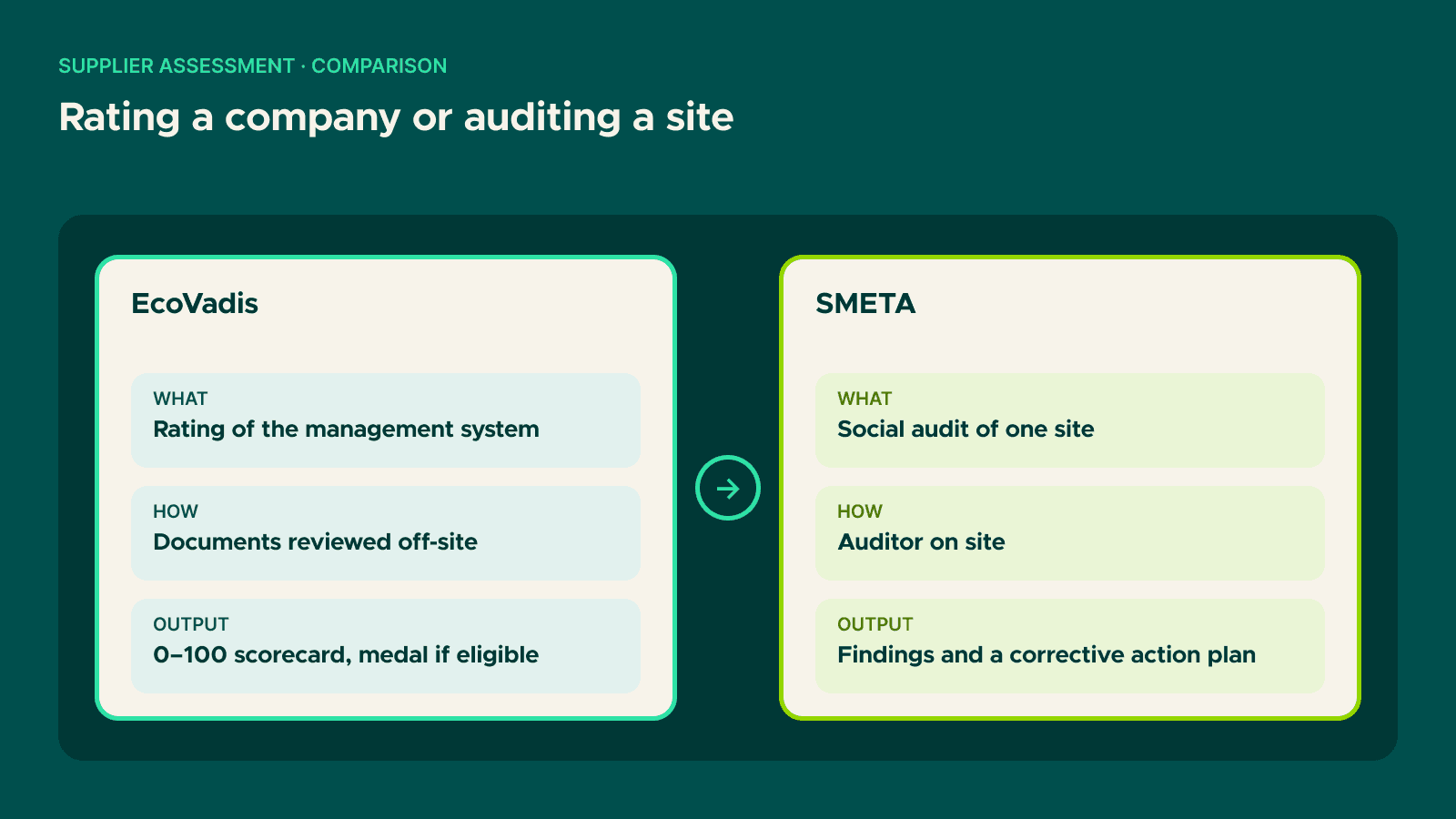
| EcoVadis Sustainability Rating | Sedex SMETA audit | |
|---|---|---|
| What it is | A rating of the company's sustainability management system | A social audit methodology (Sedex Members Ethical Trade Audit) |
| Unit assessed | The company (or the entity rated) | One site |
| How | Questionnaire and documents reviewed off-site; on-site verification only in exceptional cases | Independent auditor on site, from a Sedex Affiliate Audit Company |
| Scope | 4 themes, 21 criteria: environment, labour and human rights, ethics, sustainable procurement | Labour standards and health and safety; the 4-Pillar audit adds environment and business ethics |
| Reference | EcoVadis methodology (V10.0, applicable from January 2026), with its 21 criteria mapped to ISO 26000 | Local law and the ETI Base Code, which is founded on ILO Conventions |
| Output | Scorecard, 0–100 overall score, medal if eligible | Findings of non-compliance, a management systems grading and a Corrective Action Plan |
| Validity | Scorecard valid 12 months from publication | No pass/fail and no certificate; results shared on the Sedex Platform |
Two points in that table matter most. EcoVadis ranks you: medals go to the top 35% (Bronze), 15% (Silver), 5% (Gold) and 1% (Platinum) by percentile. Sedex does not: it states that it "is not a certification body and does not impose a pass/fail model within the SMETA audit."
The wording of the request usually tells you.
If the request is unclear, confirm with the buyer before you commit budget: a medal and an audit take different preparation and different people on your side.
Neither is named in the directive. Directive (EU) 2024/1760 lets a company verify a business partner's contractual assurances through "independent third-party verification, including through industry or multi-stakeholder initiatives". It does not list EcoVadis, Sedex or any other scheme.
The scope also changed in 2026. Directive (EU) 2026/470, the Omnibus I amendment published in the Official Journal on 26 February 2026, rewrote the thresholds and dates:
| After Directive (EU) 2026/470 | |
|---|---|
| EU companies in scope | More than 5,000 employees and more than EUR 1.5 billion net worldwide turnover |
| Non-EU companies in scope | More than EUR 1.5 billion net turnover generated in the EU |
| Transposition deadline | 26 July 2028 |
| Rules apply from | 26 July 2029 (the annual statement under Article 16: financial years starting on or after 1 January 2030) |
| Climate transition plan (Article 22) | Deleted |
| Cap on fines | 3% of net worldwide turnover |
For a Turkish supplier, the practical effect is indirect. Few will meet the EUR 1.5 billion EU-turnover test themselves; they meet the CSDDD through the due diligence of EU customers that are in scope. The amended text also limits those customers: from business partners with fewer than 5,000 employees, they may request information only when it cannot reasonably be obtained by other means. The directive does not name any scheme here, but in our reading a current EcoVadis scorecard or a SMETA report on the Sedex Platform can be the kind of existing information that spares you a separate questionnaire.
Sedex itself sets the limit on what an audit proves. Its SMETA guidance says audits "alone cannot resolve severe social and labour issues" and work best inside wider programmes of risk assessment, remediation and supplier engagement. The same holds for a rating. A medal shows your management system; it does not show that a specific risk at a specific site has been prevented.
For the buyer's side of this question, see why EcoVadis matters more under the CSDDD.
An exporter selling to several large buyers can receive both: an EcoVadis invitation from one customer and a SMETA request from another. The two are not separate projects if you build one evidence base.
Choosing which audit and policy files to upload is a decision, not a formality; our EcoVadis document checklist lists what to prioritise.
The companies that struggle are not the ones with weak practices. They are the ones answering each customer request from scratch, with a different set of documents each time.
Semtrio is EcoVadis Accredited and holds an EcoVadis Platinum medal (2026). We run EcoVadis advisory alongside supplier ESG due diligence.
Our clients' results: the average EcoVadis score of our active clients is 82.1. 54%+ of our clients hold a Gold medal or above. Past results, not a guarantee of future scores.
Neither is named in the CSDDD. The directive allows independent third-party verification, including through industry or multi-stakeholder initiatives, and leaves the choice of tools to the company. Use the one your customer's due diligence programme runs on.
No. Sedex states that it is not a certification body and that SMETA has no pass/fail model. The audit records non-compliances and a Corrective Action Plan, and results are shared through the Sedex Platform.
In principle, no. EcoVadis assesses documents and questionnaire answers off-site, and uses on-site verification only in exceptional cases, for a small number of suppliers selected on risk criteria.
It can count as evidence. EcoVadis assesses valid third-party audits under its Certifications indicator, and corrective actions you have documented after an audit support the Measures indicator. The score still depends on the full set of evidence.
Under Directive (EU) 2026/470, Member States must transpose the rules by 26 July 2028 and apply them from 26 July 2029; the annual statement applies for financial years starting on or after 1 January 2030. In-scope EU companies have more than 5,000 employees and more than EUR 1.5 billion net worldwide turnover.
Every SMETA audit covers labour standards and health and safety. The 4-Pillar audit adds environment and business ethics; Sedex says around 70% of audits now use it.
Related reading: How does the EcoVadis scoring system work? · EcoVadis medals explained · EcoVadis vs CDP
If a customer has sent you an EcoVadis invitation, a SMETA request or both, EcoVadis advisory starts with a scoping call that maps each request to the documents you already have and lists what is missing for each one.
Get in touch
If something you've read here connects to a live project, a reporting deadline, or a decision you're weighing — we're happy to have a useful conversation.
Contact usLets talk about your sustainability goals.


