Blog
Publish: 16 Nov 26Reading Time: 7 Min
An internal carbon price is a cost per tonne of greenhouse gas emissions that a company applies to its own decisions, either as a notional shadow price in investment appraisals or as an internal fee charged to business units. Companies usually set the level from projected regulatory prices, peer benchmarks or the abatement cost of their own targets. IFRS S2 paragraph 29(f) asks companies to disclose whether and how they use such a price, and the price per tonne.
IFRS S2 defines an internal carbon price as the price an entity uses to assess the financial implications of changes to investment, production and consumption patterns, as well as potential technological progress and future emissions-abatement costs. It names two common types: a shadow price and an internal tax or fee. CDP's carbon pricing guidance also describes an implicit price, which some companies with reduction or renewable energy targets calculate, and internal trading between business units.
| Type | How it works | Does money move? | Typical use |
|---|---|---|---|
| Shadow price | A notional cost per tonne added to a project appraisal | No | Capital expenditure, net present value, scenario analysis |
| Internal fee | A charge to a business unit based on its emissions; the revenue is often reinvested in low-carbon projects | Yes, inside the company | Changing behaviour in units and funding reduction projects |
| Implicit price | The cost of abatement or procurement divided by the tonnes of CO₂e abated | No new charge; it is derived from money already spent on abatement | A benchmark for setting a more strategic price |
Shadow pricing is the most common choice: CDP's 2025 Disclosure Dividend report names it the most widely adopted type of internal carbon pricing. The same report found that only 19% of companies disclosing in the 2024 cycle put an internal price on environmental externalities. For most companies, then, setting a price is still a first-time decision.
An internal price is a management tool, not a compliance cost. External prices come from emissions trading systems, carbon taxes and, for goods imported into the EU, the CBAM certificate price paid by the authorised CBAM declarant, which is calculated from EU ETS allowance auction prices. Those external prices are often the first input to an internal one.
CDP's guidance describes four common ways to set the level. The first two suit risk assessment and scenario analysis. The last two suit a price that is meant to drive decarbonisation.
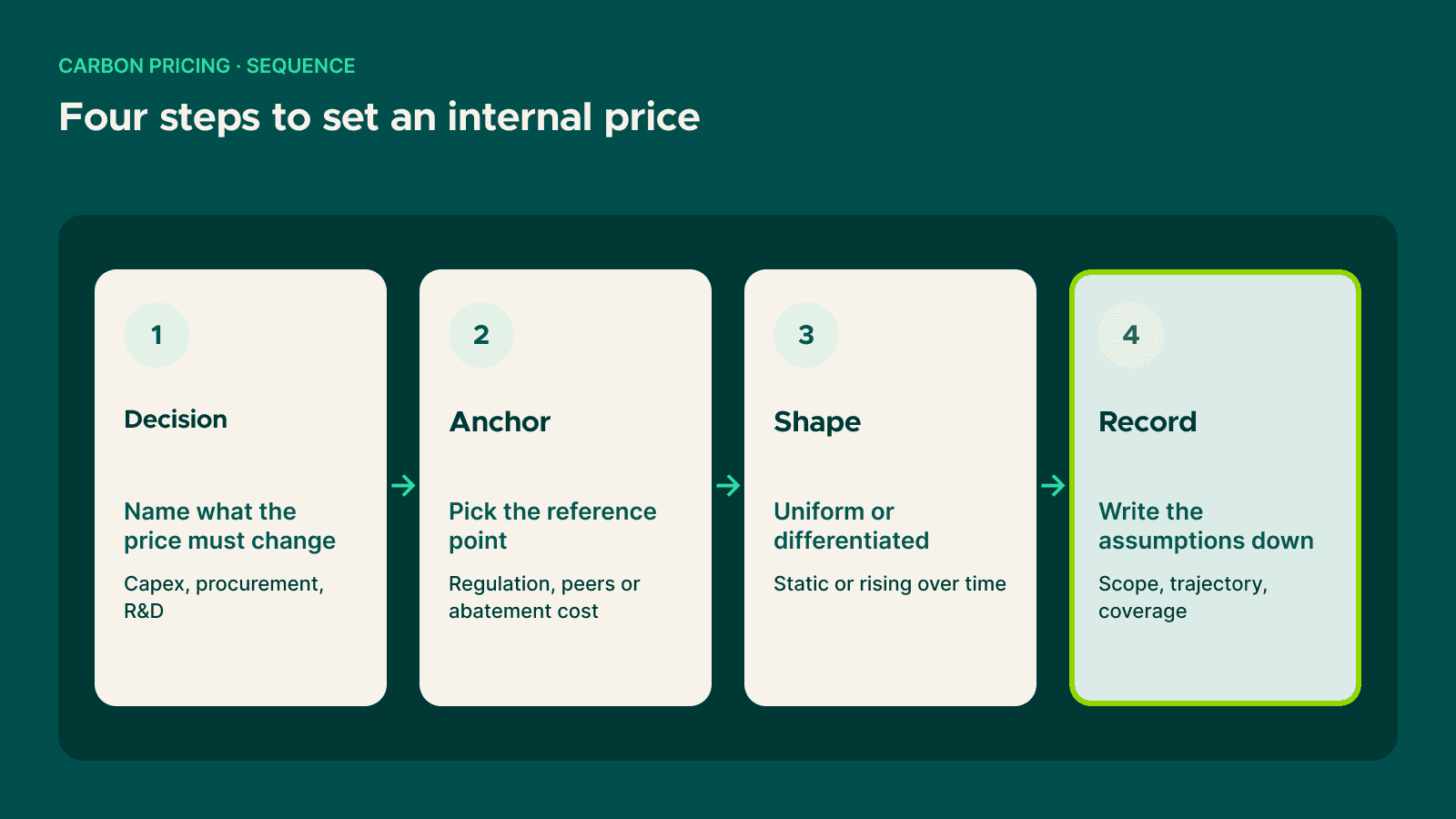
A differentiated price can be simple. One company quoted in CDP's guidance uses two levels: €30 per tonne for its largest investments, such as new plants, and €100 per tonne to guide long-term R&D budgets beyond 2030. The company reports that the €30 price led it to choose gas over coal to power a new plant.
| Reference point | What it says | Source |
|---|---|---|
| High-Level Commission on Carbon Prices (2017) | An explicit carbon price consistent with the Paris temperature target is at least US$40–80/tCO₂ by 2020 and US$50–100/tCO₂ by 2030, provided a supportive policy environment is in place | Carbon Pricing Leadership Coalition |
| CDP 2024 disclosure cycle | About half of the internal prices companies reported fell between US$9 and US$124 | CDP Disclosure Dividend 2025 |
| EU ETS and CBAM | The CBAM certificate price is the weekly average of EU ETS allowance auction closing prices; emissions declared for 2026 use a quarterly average | Regulation (EU) 2023/956, Article 21 |
If your EU customers import CBAM goods from you, the cost they face starts from the EU ETS-based certificate price, adjusted for EU free allocation and for any carbon price effectively paid in the country of origin. A shadow price far below that level is unlikely to change decisions on those products. Our guides to the EU ETS for non-EU companies and CBAM certificate pricing explain how that external price reaches you.
A price only matters if it changes a decision. CDP's guidance ranks how strongly companies apply the price, from weakest to strongest:
The guidance also maps emission scopes to the decisions they usually sit in. Scope 1 links to investment and production decisions, Scope 2 to energy purchasing, upstream Scope 3 to materials sourcing and procurement, and downstream Scope 3 to R&D for new products. Use that map to decide where your price applies first, starting with the scope that carries most of your emissions.
A quick test: name one decision from the last 12 months where the price changed the outcome. If you can't, the price is a disclosure line rather than a management tool.
IFRS S2. Internal carbon prices are one of the cross-industry metrics in paragraph 29, so they apply to IFRS S2 reporters in every industry, subject to the materiality requirements of IFRS S1. Paragraph 29(f) asks for:
The word "whether" matters. IFRS S2 does not make you adopt a price; where the information is material, a company without one explains that it does not apply one. In our experience, readers compare the price in your IFRS S2 scenario analysis with the one disclosed under paragraph 29(f), so keep them the same or explain the difference.
CDP. CDP's corporate questionnaire asks whether you use an internal price on environmental externalities (question 5.10 in the 2024–2025 structure), then asks for details of the carbon price (5.10.1). CDP's guidance for that table covers the objective, GHG scope coverage, business application, type of mechanism, price level and the method used to set it. CDP notes that some companies withhold the price level for competitive reasons, but investors ask for it and for the method. For how this feeds your score, see CDP disclosure explained.
The price that holds up under review is the one with a written decision rule behind it: which projects it applies to, at what level, and who signs off when it changes the outcome. In IFRS S2 scenario work for an exporter whose EU sales fall under CBAM, a carbon price is the variable that turns a transition scenario into a cost line. Sustainability strategy advisory sets that rule and the price behind it. IFRS S1 and S2 advisory writes it into the disclosure.
Neither IFRS S2 nor CDP requires you to adopt one. IFRS S2 paragraph 29(f) requires you to disclose whether and how you apply a carbon price and at what level, so a company that reports under IFRS S2 without one explains that, where the information is material.
A shadow price is a notional cost added to appraisals; no money changes hands. An internal fee charges business units for their emissions, and the revenue is often reinvested in low-carbon projects inside the company.
There is no single correct number. Start from the decision the price must change, then test the level against the external prices you face, such as the EU ETS price behind CBAM certificates, against peer benchmarks, and against the abatement cost of your own targets.
It can. CDP's guidance links upstream Scope 3 to sourcing and procurement decisions and downstream Scope 3 to R&D. A practical order is to start with Scope 1 and 2 in capital expenditure, then add Scope 3 once supplier data is reliable enough to price.
CDP notes that some companies report the cost of the offsets they buy as their internal price. A price set that way reflects what you pay to compensate, not what it costs to cut your own emissions. CDP's guidance notes that the focus has been on driving down emissions within the company itself.
Book a scoping call on internal carbon pricing and leave with a list of the capital expenditure and procurement decisions your price should change, plus the inputs your IFRS S2 paragraph 29(f) disclosure needs: Sustainability strategy advisory.
Get in touch
If something you've read here connects to a live project, a reporting deadline, or a decision you're weighing — we're happy to have a useful conversation.
Contact usLets talk about your sustainability goals.


