Blog
Publish: 16 Nov 26Reading Time: 7 Min
To choose a CDP advisor, check six things: whether the firm is in CDP's Accredited Solutions Provider network, whether it starts from your score report question by question, whether it can build the emissions and risk data behind the answers, whether it plans to the scoring deadline, how it presents its results, and what your team keeps afterwards. No advisor can promise a score: CDP scores responses mainly through automated systems, with CDP-trained accredited scoring partners for open-text answers, and CDP's own team collates and checks the scores.
Last checked: 16 November 2026.
A CDP score is decided by evidence, not by wording. Each answer is assessed on four levels, Disclosure, Awareness, Management and Leadership, and a response only moves up a level when it shows what that level requires. Our guide to CDP scores and the 2027 timeline explains the levels in detail.
That shapes what you are buying. An advisor who only drafts text can make a response complete, but completeness alone keeps it at the lower levels. The points at Management and Leadership depend on things that exist before the questionnaire opens: board oversight, targets, a defensible emissions inventory, quantified risks. The right advisor works on those.
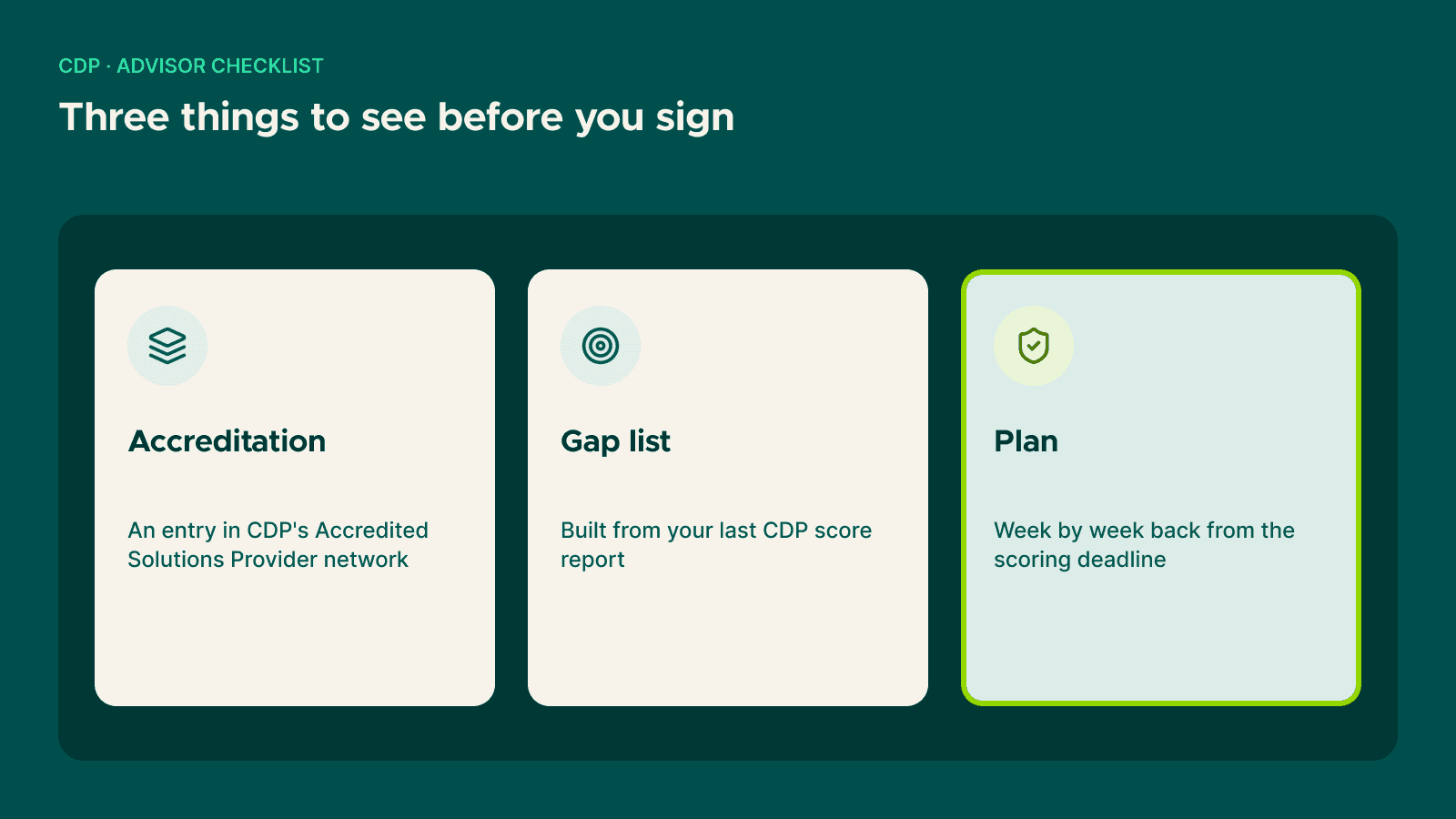
CDP runs a network of Accredited Solutions Providers: consultancies, software providers and verification providers it has accredited to support disclosing companies. Look the firm up in that network on cdp.net rather than relying on a logo in a proposal, and ask which of its services the accreditation covers.
Accreditation is not part of CDP's scoring process, and Accredited Solutions Providers are not the same as the accredited scoring partners CDP uses. The accreditation tells you who is in CDP's network, not what score you will get.
A good first deliverable is a gap list built from your last score report: which questions lost points, at which level, and what evidence each one needs. CDP offers Score Feedback Calls, available to all companies in 2026 (with limited availability for non-members), and a capable advisor will use them.
For first-time disclosers, the equivalent is a baseline against the current questionnaire. In both cases, ask to see a sample gap list before you sign.
Points are often lost on data: an inventory boundary nobody documented, Scope 3 categories estimated without a method, a climate risk with no financial figure attached. Ask whether the advisor can do the corporate GHG accounting, the Scope 3 screening and the risk quantification itself, or whether it expects you to bring finished numbers.
If you also report under GRI or IFRS S2, ask how the same data will serve all of them, so it is collected once rather than once per framework.
For 2027, CDP's scoring deadline falls in the week of 26 July; the final response deadline in the week of 6 September. Only responses submitted by the scoring deadline are scored. A plan that aims for September produces a disclosure without a score.
Ask for the work plan in weeks: when the gap list arrives, when data collection closes, when drafts go to internal review, and when the response is submitted.
Look for results with a base and a year: how many projects, how many reached the A List, in which cycle. A single percentage without a project count tells you little.
Also ask what happened to clients who did not improve. An advisor who can explain a flat year is usually one who understands the methodology.
CDP lets consultants act as contributors, which means they can access their clients' responses. That is useful, but the response, the data templates and the evidence files should stay with your team. Ask what you will hold at the end: module-by-module templates, a documented boundary and method, an evidence folder per question, and someone in-house who can explain every answer.
| Red flag | Why it matters |
|---|---|
| "We guarantee an A" | Scores come from CDP's scoring process. Nobody outside it can guarantee one |
| "CDP-certified" or "CDP-approved" consultant | The term CDP uses is Accredited Solutions Provider; ask for the network entry, not a self-chosen label |
| A plan aimed at the final deadline | Responses after the scoring deadline are not scored |
| Templates handed over without data work | Complete answers without evidence stay at the lower levels |
| Results with no base or year | You cannot judge a percentage without the number of projects behind it |
| The advisor submits and you cannot explain the answers | Next year starts from zero, and investors' or customers' follow-up questions land on you |
The same logic applies to other ratings; compare it with our checklist for choosing an EcoVadis consultant.
Semtrio is a CDP Accredited Solutions Provider, with 100+ CDP reports prepared.
Our clients' results: in 2025, 33 of the 44 projects we supported reached the A List (75%). 100% of our clients have either improved their score or kept their A List position. Past results, not a guarantee of future scores.
The client's team stays in the lead. At Turkcell, the sustainability team ran a gap analysis against underperforming sections from prior cycles, with data templates for each questionnaire module. At Sabancı Holding, boundaries and the group's GHG consolidation approach were confirmed jointly for a group-level response. Ford Otosan's own team led its 2025 disclosure, with Semtrio as methodological guide.
It is a provider in CDP's accredited network that supports companies with disclosure, such as a consultancy, software provider or verification provider. Accreditation is not part of CDP's scoring process, which runs on automated systems, CDP-trained scoring partners and CDP's own team.
No. CDP scores responses mainly through automated systems, supplemented by CDP-trained accredited scoring partners for open-text answers, with CDP's own team collating and checking the scores. A consultant can improve your evidence, not decide the score.
Yes. CDP allows consultants to act as contributors with access to their clients' responses. Keep ownership of the response and the evidence files with your own team.
Early enough to fix the evidence, not just the text. The scoring deadline is the week of 26 July 2027, so the gap list and data work should start well before the response window opens in late April.
Not necessarily. Once your team owns the data, templates and method, the advisor's role can shrink to a review of gaps and methodology changes. Ask any advisor how they plan to hand the work over.
Related reading: CDP disclosure explained · GRI vs CDP: reporting vs rating · EcoVadis vs CDP
Before you choose, ask for a question-by-question gap list from your current CDP score report; CDP advisory starts there, with an owner and a date for each missing piece of evidence before the 2027 scoring deadline.
Get in touch
If something you've read here connects to a live project, a reporting deadline, or a decision you're weighing — we're happy to have a useful conversation.
Contact usLets talk about your sustainability goals.


