Blog
Publish: 02 Sep 26Reading Time: 4 Min
Choosing an EcoVadis consultant comes down to verifying three things: official accreditation as an EcoVadis Consulting Partner, a documented track record of score improvement across clients, and a methodology built on evidence documentation rather than generic ESG advisory language.
EcoVadis maintains an Accredited Consulting Partner program, and confirming a consultant's status within it is a reasonable first filter. Accreditation signals a working relationship with, and familiarity with, EcoVadis's own methodology, rather than a general sustainability consultancy applying broad ESG advisory experience to an unfamiliar rating system. Given that EcoVadis scoring is a specific, evidence-based methodology across four defined themes, as explained in How Does the EcoVadis Scoring System Work?, familiarity with that specific system matters more than general sustainability expertise.
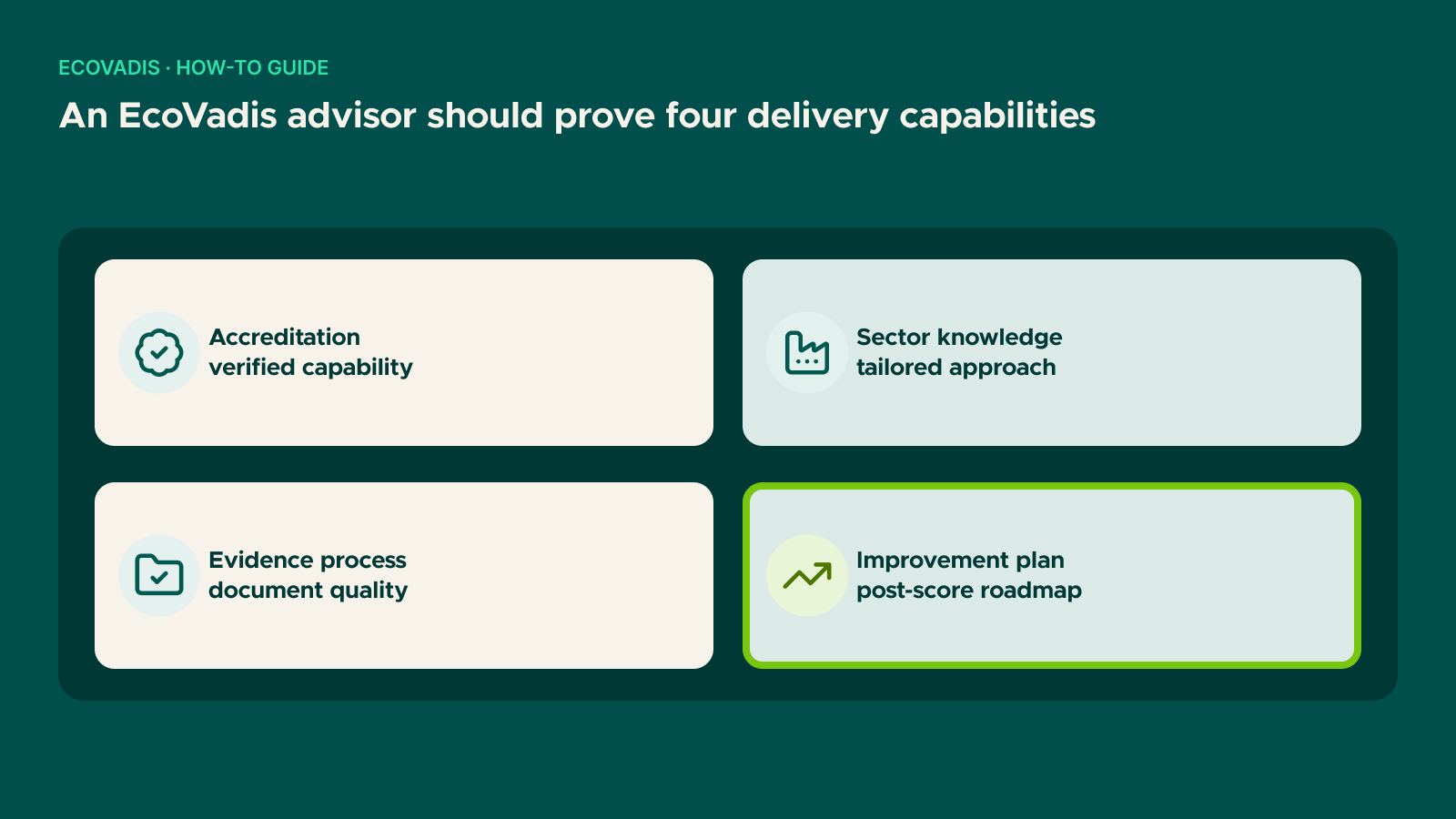
A credible EcoVadis consultant should be able to point to concrete, verifiable outcomes: average score improvements achieved for clients, medal-earning rates, and whether results are measured against a meaningful baseline such as the global first-year average score. Vague claims about "improving sustainability performance" without specific score data are a weaker signal than a consultant willing to share average point improvements and medal outcomes directly.
It is also worth asking whether a consultant's track record includes returning clients — companies that have gone through more than one assessment cycle with the same support — since this indicates the consultant's approach compounds over time rather than producing a one-time bump followed by stagnation.
This is the most important substantive question to ask directly. The most reliable lever for EcoVadis score improvement is documented policy evidence and verifiable action records, not ambitious commitments alone. A consultant whose process centers on drafting aspirational policy language or sustainability messaging, without a parallel focus on implementation records, training documentation, and monitoring data, is likely to produce a weaker outcome than one whose process is built around evidence-gathering and documentation discipline. This distinction is explored in depth in How to Improve Your EcoVadis Score: A Practical Guide.
A useful practical test: ask a prospective consultant to walk through how they would approach the weakest of the four themes for a hypothetical client. A methodology-driven answer should reference specific evidence types (policy, implementation record, outcome data) rather than general strategic language.
Because EcoVadis medal thresholds are percentile-based and have been trending upward — third-party tracking shows Silver moving from roughly 68 to roughly 72 and Gold from roughly 77 to roughly 78 between mid-2025 and early 2026 — a consultant should be able to speak to this dynamic and set targets accordingly, rather than benchmarking solely against last year's published thresholds. A consultant unaware of this shift risks setting a target that falls short by the time an assessment is actually reviewed. This mechanic is detailed in EcoVadis Medals Explained: Bronze, Silver, Gold, and Platinum.
A sound engagement typically starts with a structured document and policy audit against all four EcoVadis themes, followed by a prioritized gap-closing plan (starting with the weakest theme, since medals require a minimum of 30 in each), and a defined timeline aligned to the client's actual submission deadline. Consultants who skip the audit step and move straight to policy drafting are more likely to produce documentation that reads well but does not map cleanly to how EcoVadis analysts actually score evidence. A full picture of what documentation is typically required is available in Preparing for Your EcoVadis Assessment: Document Checklist.
Semtrio Note: Semtrio is an EcoVadis Accredited Consulting Partner and itself holds Platinum status — meaning its own documentation practices meet the top 1% standard it advises clients toward. Organizations Semtrio supports achieve an average first-year improvement of 25.6 points, reaching an average client score of 73.2 against a global first-year average of 48.4, with a 100% medal-earning rate. Returning clients see a further average improvement of 10.5 points.
Semtrio's own EcoVadis Platinum status and Accredited Consulting Partner standing reflect the same evidence-based methodology it applies to client engagements. Visit Semtrio's EcoVadis consulting page to review the approach directly, or discuss a specific assessment timeline with the team.
Yes — accreditation is granted directly by EcoVadis, and prospective clients can confirm a consultant's status as part of due diligence before engaging.
Be cautious of firm guarantees on a specific medal, since thresholds are percentile-based and move year to year; a credible consultant should speak in terms of target score ranges and evidence gaps rather than an absolute promise.
Timelines vary based on a company's starting documentation and the submission deadline, but engagements generally begin with an audit phase followed by a structured gap-closing period ahead of submission.
Yes — returning clients typically see continued score gains, since evidence-building and monitoring practices compound across cycles rather than being a one-time effort.
If you are evaluating EcoVadis consulting support, talk to Semtrio's team about its Accredited Partner status, track record, and methodology directly.
Get in touch
If something you've read here connects to a live project, a reporting deadline, or a decision you're weighing — we're happy to have a useful conversation.
Contact us
Regulation & Compliance
Regulation & Compliance
Regulation & Compliance
Lets talk about your sustainability goals.


