Blog
Publish: 23 Nov 26Reading Time: 7 Min
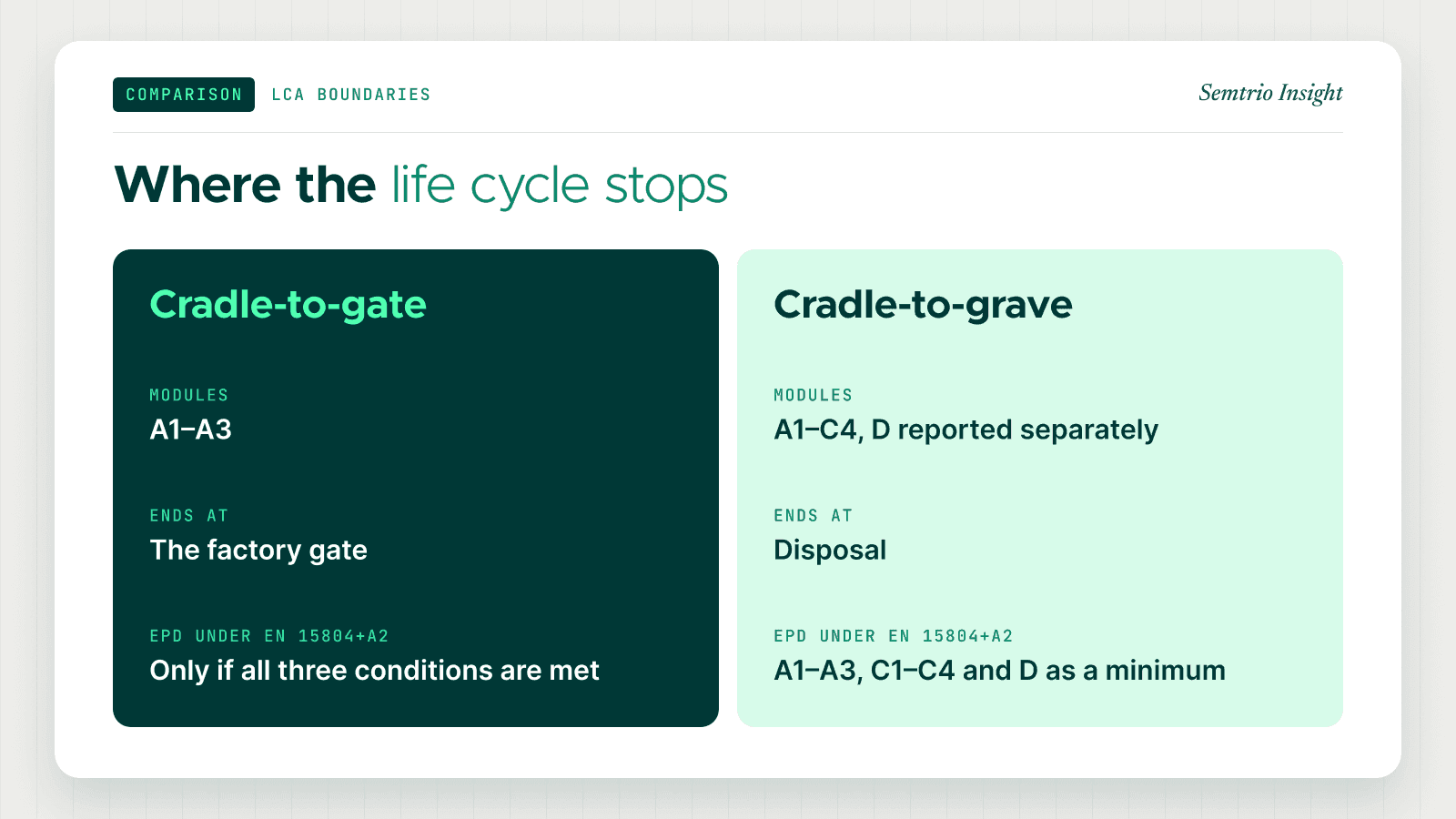
Cradle-to-gate means a life cycle assessment covers a product from raw material extraction to the moment it leaves the factory gate; cradle-to-grave continues through transport, installation, use and end of life. In EN 15804 terms, cradle-to-gate is modules A1–A3 and cradle-to-grave is A1 to C4. For a construction product EPD under EN 15804+A2, the minimum is A1–A3 plus C1–C4 and D, and a gate-only EPD is allowed only when three conditions are all met.
Both terms describe the system boundary of a life cycle assessment (LCA): which processes are counted. ISO 14040 defines the life cycle as the consecutive, interlinked stages of a product system, from raw material acquisition or generation from natural resources to final disposal. A study that follows that full path is cradle-to-grave. A study that stops when the product leaves the manufacturer is cradle-to-gate.
The boundary is set in the goal and scope of the study; ISO 14040 defines it as the set of criteria specifying which unit processes are part of a product system. The choice matters because the two results answer different questions and cannot be compared with each other.
EN 15804, the European standard for construction product EPDs, splits the life cycle into lettered modules. Construction product EPDs report their results in this structure.
| Stage | Modules | Cradle-to-gate | Cradle-to-grave |
|---|---|---|---|
| Product stage | A1 raw material supply · A2 transport to the manufacturer · A3 manufacturing | ✓ | ✓ |
| Construction stage | A4 transport to site · A5 installation | — | ✓ |
| Use stage | B1 use · B2 maintenance · B3 repair · B4 replacement · B5 refurbishment · B6 operational energy · B7 operational water | — | ✓ |
| End-of-life stage | C1 deconstruction and demolition · C2 transport to waste processing · C3 waste processing · C4 disposal | — | ✓ |
| Beyond the system boundary | D benefits and loads from reuse, recovery and recycling | — | Reported separately |
Module D sits outside the product's life cycle. EN 15804 calls it "benefits and loads beyond the system boundary", such as those from reuse, recycling or energy recovery after end of life, and it is reported next to the A–C results rather than added into them.
Under EN 15804+A2, a construction product EPD declares A1–A3, C1–C4 and D as a minimum. The construction and use modules (A4–A5, B1–B7) are added where the product category rules (PCR) require them; ECO Platform's rules, for example, require B6 for final products that consume energy.
A cradle-to-gate EPD (A1–A3 only) is permitted under clause 5.2 of EN 15804+A2 only if the product meets all three conditions, as ECO Platform's calculation rules set them out:
The test is about the product, not the producer's preference. On our reading, a façade panel, a window or a steel section that can be removed and identified at end of life would fail the first two conditions, so its EPD declares end of life even if the manufacturer never sees the product again.
The EPD itself is a Type III environmental declaration under ISO 14025, which bases each declaration on PCR for the product category. EN 15804 provides the core PCR for construction products, and complementary PCRs add rules for specific product groups. Our guide on how to get an EPD walks through the steps from PCR to publication.
ISO 14067 covers the carbon footprint of a product (CFP): the greenhouse gas emissions and removals of a product system, in CO₂ equivalents, based on an LCA that uses climate change as its single impact category. A full CFP follows the life cycle. ISO 14067 also defines a partial CFP, based on selected stages or processes of the life cycle. A cradle-to-gate product footprint is a partial CFP.
A cradle-to-gate footprint is often the only one a supplier can calculate with its own data. A producer of steel coil, aluminium billet or glass does not control what its customer makes from the material, so its use and end-of-life stages depend on someone else's product. The customer then adds its own stages. Name the boundary in the result, for example "kg CO₂e per tonne, cradle-to-gate (A1–A3)", so the number is not read as a full life cycle figure. Where a PCR applies to your product, it sets the boundary for you.
Start from who will use the number and what they will do with it:
No. CBAM embedded emissions cover the production process at the installation and relevant precursor materials, under boundaries set by the CBAM rules; the UK CBAM, for example, mirrors UK ETS boundaries and includes precursor goods. The figure covers greenhouse gases only, follows CBAM's own monitoring and allocation rules, and is limited to the processes and precursors those rules list, while an A1–A3 result covers the whole upstream supply chain. The two numbers can share data, but one cannot stand in for the other. Our guide to calculating CBAM embedded emissions and system boundaries explains the CBAM side.
The boundary question usually arrives as a customer request: a façade contractor asks for an EPD, a buyer asks for a product footprint, an EU importer asks for CBAM data. Producers who answer each one separately end up with three numbers for the same product and no explanation of why they differ. Producers who keep one LCA model and report from it per boundary can show where each figure starts and stops. Our case studies on life cycle assessment across Şişecam's glass packaging product lines and Assan Alüminyum's environmental product declaration show that work in two materials. Life cycle assessment, environmental product declaration and product carbon footprint services build the model and the outputs from it.
Cradle-to-grave is an LCA boundary that covers a product's whole life: raw material extraction, manufacturing, distribution, installation, use, and end of life through to disposal. In EN 15804 terms it covers modules A1 to C4, with module D reported separately.
Cradle-to-gate stops when the product leaves the factory (A1–A3). Cradle-to-grave adds transport to site, installation, use and end of life (A4–C4). The results answer different questions and should not be compared with each other.
Only if the product meets all three conditions in clause 5.2: it is physically integrated with other products so it can't be separated at end of life, it is no longer identifiable at end of life after a physical or chemical transformation, and it contains no biogenic carbon. Otherwise the EPD declares A1–A3, C1–C4 and D as a minimum.
Module D reports the net benefits and loads beyond the system boundary from reuse, recycling or energy recovery after end of life. It is shown next to the life cycle results, not added into them.
It can be. ISO 14067 allows a partial CFP based on selected stages, which covers cradle-to-gate, as long as the boundary is stated. Check whether a PCR for your product or your customer's request sets a wider boundary.
Book a scoping call and leave with the boundary your EPD or product footprint needs, the PCR that applies, and the list of downstream data you will have to collect: Environmental product declaration.
Get in touch
If something you've read here connects to a live project, a reporting deadline, or a decision you're weighing — we're happy to have a useful conversation.
Contact usLets talk about your sustainability goals.