Blog
Publish: 23 Nov 26Reading Time: 7 Min
Transition risk is the risk that arises from efforts to move to a lower-carbon economy: new climate policy and litigation, low-carbon technology, shifting markets and changing views of your sector. IFRS S2 requires you to say which of your climate-related risks are transition risks, over what time horizon, and how they affect your strategy, cash flows and financial position. It also asks for one number: the amount and percentage of assets or business activities vulnerable to transition risks (paragraph 29(b)).
IFRS S2 defines climate-related transition risks as "risks that arise from efforts to transition to a lower-carbon economy". Its definition names policy, legal, technological, market and reputational risks, and gives examples of their financial effect: higher operating costs or asset impairment from new climate regulation, and lower performance from shifting customer demand or new technology.
The opposite category is physical risk: damage and disruption from the climate itself, either from events such as floods (acute) or from longer-term shifts such as rising temperatures (chronic). Under IFRS S2 paragraph 10(b), every climate-related risk you disclose has to be classed as one or the other. See our glossary entry on transition risk.
The Task Force on Climate-related Financial Disclosures (TCFD) set out four types in its 2017 recommendations. IFRS S2 builds on those recommendations, so the TCFD list is still a practical way to structure a risk register.
| Type | Examples of the risk (TCFD) | Examples of the financial effect (TCFD) |
|---|---|---|
| Policy and legal | Higher pricing of GHG emissions; stricter emissions reporting; rules on existing products and services; exposure to litigation | Higher operating costs; write-offs and early retirement of assets; fines and judgments |
| Technology | Lower-emission substitutes for your products; unsuccessful investment in new technologies; cost of moving to lower-emission technology | Write-offs of existing assets; lower demand; R&D and capital spending |
| Market | Changing customer behaviour; uncertain market signals; higher raw material costs | Lower demand; higher input costs such as energy and water; abrupt energy-cost shifts; re-pricing of assets |
| Reputation | Shifts in consumer preferences; stigmatisation of a sector; stakeholder concern | Lower revenue; harder recruitment and retention; reduced access to capital |
For an exporter, one policy risk is already concrete. Under the EU CBAM, importers of steel, aluminium, cement, fertilisers, hydrogen and electricity pay a carbon cost tied to the EU ETS price, and a UK CBAM on five of those sectors starts on 1 January 2027. A carbon cost your customer pays on your goods is a transition risk to your margins and your share of that customer's purchases. Our guide to internal carbon pricing shows how companies turn that external price into a planning number.
IFRS S2 paragraph 25 asks how you identify, assess, prioritise and monitor climate-related risks, so the process itself is disclosed. Five steps give you a process you can describe:
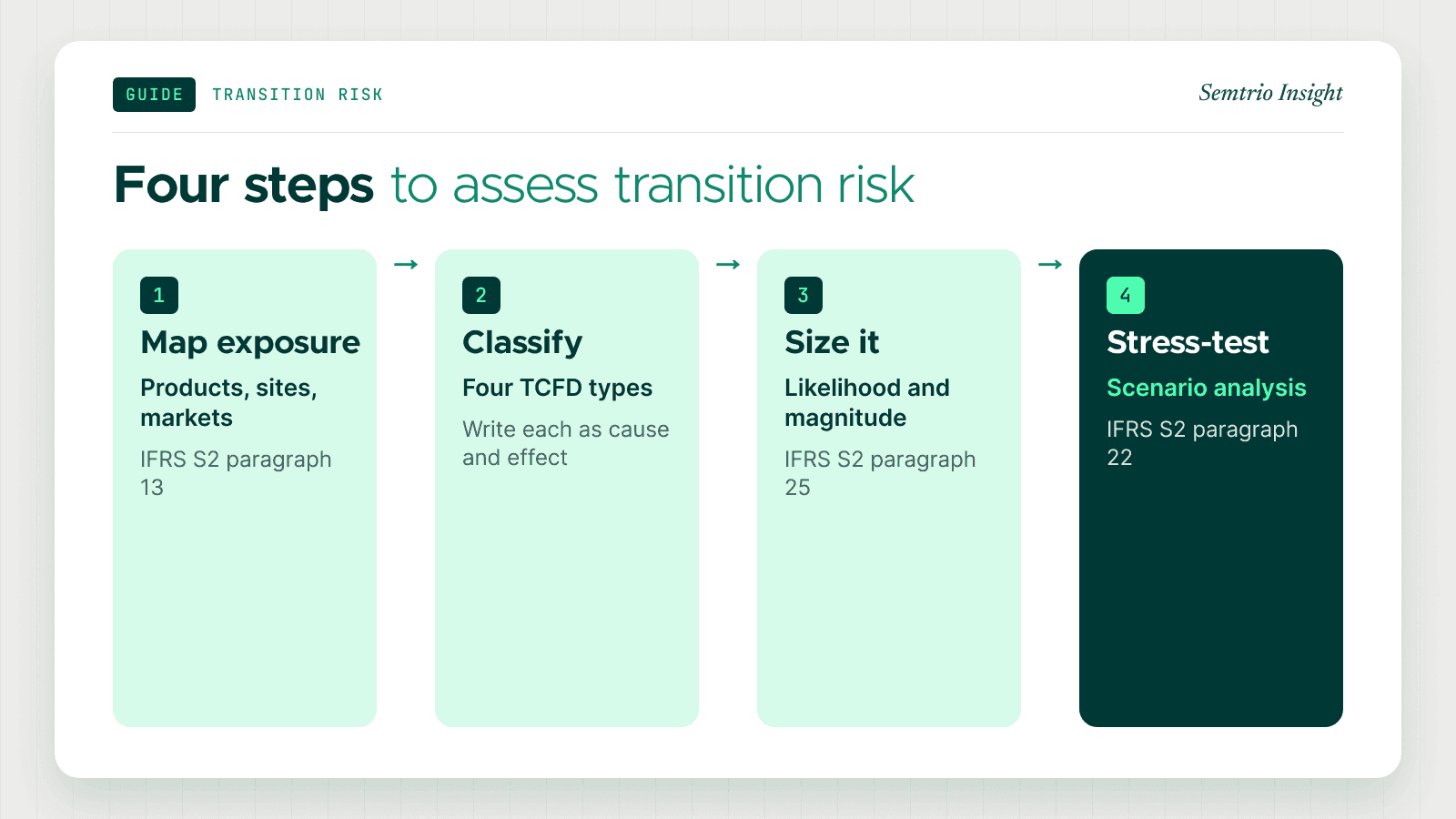
Then rank transition risk against your other risks: paragraph 25(a)(iv) asks how you prioritise climate-related risks relative to other risk types, and 25(c) how far the process is integrated into overall risk management.
IFRS S2 is effective for annual reporting periods beginning on or after 1 January 2024; whether and when it applies to you depends on adoption in your jurisdiction. Transition risk runs through the whole standard rather than sitting in one section:
| IFRS S2 paragraph | What you disclose |
|---|---|
| 10(a)–(d) | Each climate-related risk, whether it is physical or transition, its time horizon, and how you define short, medium and long term |
| 13 | Current and anticipated effects on your business model and value chain, and where the risks are concentrated |
| 14 | How the risks affect strategy and decisions, including any transition plan and how you plan to meet climate-related targets |
| 15–16 | Effects on financial position, financial performance and cash flows, for the reporting period and over the short, medium and long term |
| 22 | The resilience of your strategy and business model, assessed with scenario analysis |
| 25 | How you identify, assess, prioritise and monitor the risks, and how this fits your overall risk management |
| 29(b) | The amount and percentage of assets or business activities vulnerable to climate-related transition risks |
| 29(f) | Whether and how you apply an internal carbon price in decisions, and the price per tonne |
Two reliefs matter for a first report. For anticipated financial effects, paragraph 18 says you use "all reasonable and supportable information" available at the reporting date without undue cost or effort, with an approach commensurate with your skills, capabilities and resources. Paragraph 19 lets you leave out quantitative information on financial effects if the effects are not separately identifiable or if measurement uncertainty is so high that the figure would not be useful. Paragraph 20 adds relief for anticipated effects if you lack the skills, capabilities or resources to provide them. Paragraph 21 then requires you to explain why, to give qualitative information including the financial statement line items likely to be affected, and to give combined quantitative information unless that would not be useful. The relief covers the single number, not the disclosure.
For the wider set of disclosures, see our IFRS S1 and S2 reporting checklist.
IFRS S2 asks for the amount and percentage of assets or business activities vulnerable to transition risks, but it does not fix one formula. Companies choose a base (assets, revenue or another measure of business activity) and a test for "vulnerable". Record which assets or activities you counted, why they meet your test, and the base of the percentage, and keep both the same from year to year so the figures can be compared.
A common test for an exporter is exposure to a carbon price: revenue from products covered by a CBAM, or carrying amounts of plants whose output would face a carbon cost under your transition scenario. The scenario and the 29(b) number then come from the same assumptions.
Transition risk disclosures hold up when each risk traces back to a line in the emissions inventory and a price in the scenario. Where that link is missing, the same risk appears with different sizes in the risk register, the scenario analysis and the financial statements notes. Semtrio's track record includes Türkiye's first TCFD report, and our case study on Borçelik's IFRS S2 climate risk disclosure shows that work in the steel sector. IFRS S1 and S2 advisory builds the register, scenarios and disclosure on one set of data.
Transition risk comes from the move to a lower-carbon economy: policy, legal, technology, market and reputation changes. Physical risk comes from climate change itself, through events such as floods (acute) or long-term shifts such as rising temperatures (chronic). IFRS S2 paragraph 10(b) requires you to class each disclosed risk as one or the other.
Yes. TCFD lists increased pricing of GHG emissions as a policy and legal transition risk. Emissions trading schemes, carbon taxes and border mechanisms such as the EU and UK CBAMs all create it, either directly or through what your customers pay on your goods.
Yes. Paragraph 29(b) asks for the amount and percentage of assets or business activities vulnerable to transition risks. Quantitative information on financial effects under paragraphs 15–16 has reliefs in paragraphs 19–20, but under paragraph 21 you must explain why you used them and still give qualitative information on the effects.
IFRS S2 paragraph 22 requires climate-related scenario analysis to assess the resilience of your strategy and business model. The approach must be commensurate with your circumstances, so a qualitative or simpler quantitative analysis can be appropriate for a first report.
IFRS S2 does not set fixed years. Paragraph 10(d) asks you to define short, medium and long term yourself and link the definitions to your strategic planning horizons.
Book a scoping call and leave with a first transition-risk register in the four TCFD types, mapped to the IFRS S2 paragraphs each risk feeds: IFRS S1 and S2 advisory.
Get in touch
If something you've read here connects to a live project, a reporting deadline, or a decision you're weighing — we're happy to have a useful conversation.
Contact usLets talk about your sustainability goals.