Blog
Publish: 23 Nov 26Reading Time: 7 Min
The UK carbon border adjustment mechanism (CBAM) applies to aluminium, cement, fertilisers, hydrogen, and iron and steel imported into the UK on or after 1 January 2027. The UK importer is liable: it registers with HMRC once its CBAM imports meet or exceed £50,000, and files the first return for 2027 by 31 May 2028. The exporter pays nothing to HMRC, but its verified emissions data decides whether the importer can use actual values or must fall back on HMRC's default values.
The UK CBAM is a tax on the carbon emissions embodied in certain imported goods. HMRC's policy summary, last updated on 2 November 2026, confirms that "CBAM will commence on 1 January 2027" and applies across the whole UK, including Northern Ireland. The primary legislation is in the Finance Act 2026, with secondary legislation such as the CBAM (Emissions and Verification) Regulations 2026.
The rate is built from the UK Emissions Trading Scheme (UK ETS) price, and the system boundaries mirror the UK ETS. From January 2027 your UK customers keep records of every CBAM shipment, and the emissions figure in them is either yours or a government default.
Five sectors are in scope. The full list of commodity codes is in the annex to HMRC's policy summary.
| Sector | Examples of goods | Greenhouse gases covered |
|---|---|---|
| Aluminium | Unwrought aluminium, semi-finished and finished articles (CN 7601–7616, except 7602 and 7615) | CO₂ and perfluorocarbons |
| Cement | Clinker, Portland, aluminous and other hydraulic cements | CO₂ |
| Fertilisers | Nitric acid, ammonia, nitrates, nitrogenous and mixed fertilisers | CO₂ and N₂O (ammonia: CO₂ only) |
| Hydrogen | Hydrogen (CN 2804 10 00) | CO₂ |
| Iron and steel | Chapter 72 goods and related articles, with listed exclusions such as ferrous scrap | CO₂ |
Two differences from the EU matter for exporters selling to both markets: electricity is not on the UK list, and the UK charge is based on direct emissions embodied in the goods, including emissions from precursor goods; HMRC's summary does not price the indirect emissions from electricity used in production.
The importer. HMRC states that "the person liable for CBAM is the importer of the CBAM goods", meaning the person in whose name, or on whose behalf, the customs declaration is made. Registration and payment sit with the importer; HMRC's guidance for overseas installations covers monitoring and verification, not registration.
Liability depends on value, not tonnes. An importer must register when its CBAM imports reach £50,000, tested two ways:
Below the threshold an importer does not register or pay, but record-keeping applies to "anyone importing CBAM goods into the UK" from 1 January 2027: the 8-digit commodity code, value, net mass in kilograms and, where actual emissions are used, evidence of verification, with a £500 fixed penalty for not keeping them. This is when your customer will ask you for data.
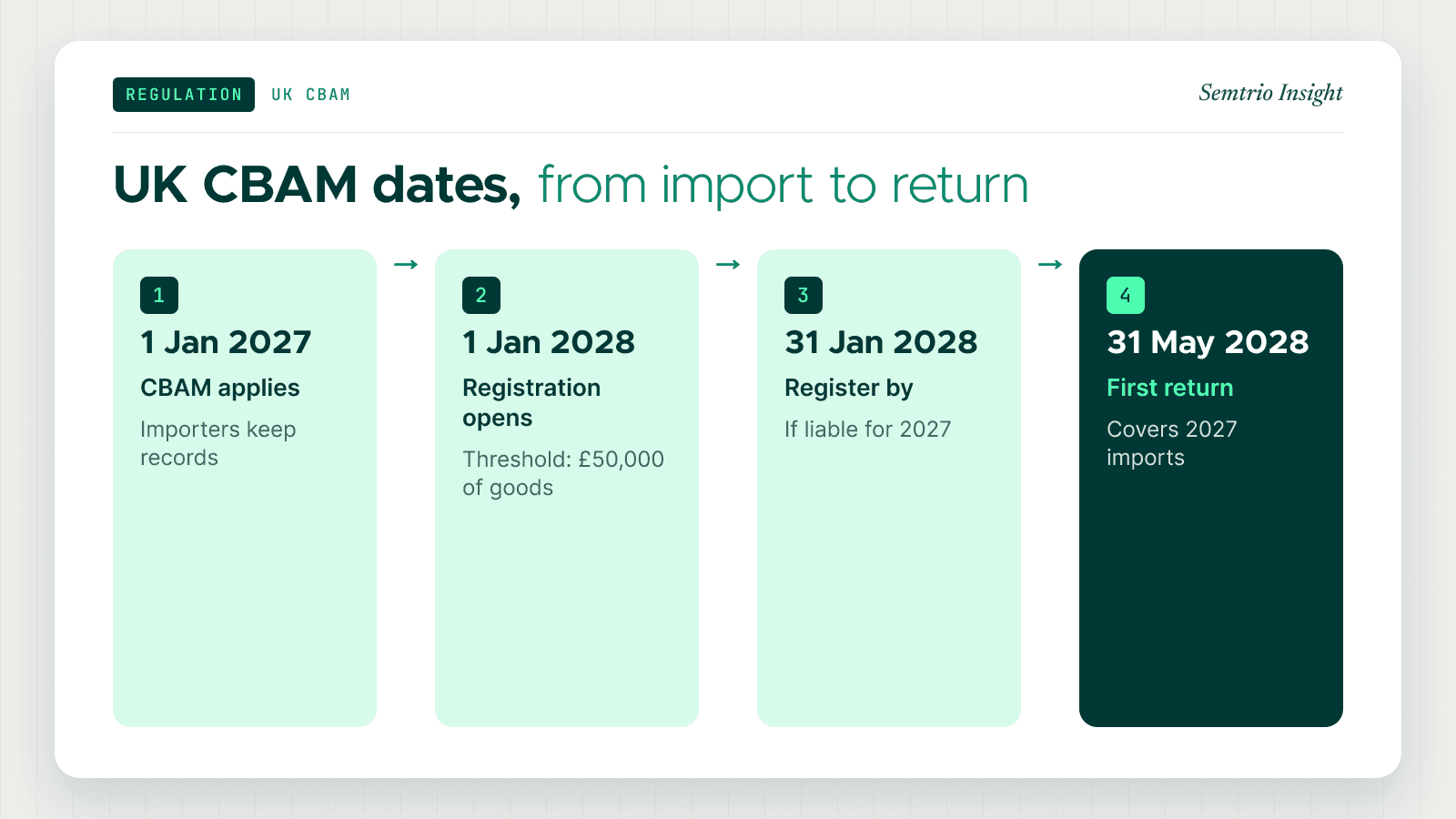
| Date | What happens | Who acts |
|---|---|---|
| 1 January 2027 | CBAM applies to imports; record-keeping starts; first quarterly CBAM rates published | Importer; HM Government |
| Each quarter from 1 January 2027 | One rate per sector published at the start of the quarter | HM Government |
| 1 January 2028 | Registration service opens | Importer |
| 31 January 2028 | Registration deadline for importers who became liable during 2027 | Importer |
| 31 May 2028 | First return and payment, covering 1 January to 31 December 2027 | Importer |
| From 2028 | Returns and payments move to quarterly periods | Importer |
The calculation has three parts:
The embodied emissions figure is where the exporter comes in. Without actual, verified data, "the importer will need to use default values provided by HMRC": one default per CBAM good from 1 January 2027, which HM Treasury may update. A default describes no particular plant, so a producer cleaner than the default has a reason to supply its own figure.
If no verified 2027 data is available, verified data from the 2026 monitoring period can be used, so a producer that monitors 2026 now has a figure ready for the first year.
If you don't monitor to the UK method, your importer falls back on HMRC's default values. These steps make the choice deliberate:
If you already supply EU CBAM data, reuse the work but don't assume it transfers. HMRC says its methods are "broadly designed to support interoperability with the EU CBAM": a design aim, not a rule that EU data is accepted. Check boundaries, gases and the verifier's accreditation against the UK guide.
| UK CBAM | EU CBAM | |
|---|---|---|
| First year of imports that carry a charge | 2027 | 2026 (definitive period) |
| Who is liable | The importer of the goods | The authorised CBAM declarant |
| Threshold | £50,000 of CBAM imports (value) | 50 tonnes a year (mass; hydrogen and electricity sit outside this threshold) |
| How it is paid | Return and payment to HMRC | Purchase and surrender of CBAM certificates |
| Electricity | Not in scope | In scope |
For the EU side, see what the EU CBAM is, CBAM and the EU ETS and who files what as a non-EU exporter.
Not yet. On 20 November 2026 the UK government said the UK and EU "have reached an agreement to link" their carbon markets, with the link meant to be operational from 1 January 2028 and to bring mutual exemptions from both CBAMs. The legal agreement is still to be published, and both sides need to pass legislation in 2027. HMRC's policy summary states that "there are currently no jurisdictions exempt from CBAM".
Nothing in the announcement exempts goods produced outside the UK and EU. Plan for 2027 on the rules as published.
Exporters who already run an EU CBAM process start ahead: the installation-level emissions data, precursor mapping and production records exist. The UK work is a second boundary check and data file per customer, not a second inventory. Our case study on CBAM compliance across Tosyalı Holding's multi-entity steel group shows what that installation-level groundwork looks like in a group with several producing companies. CBAM accounting and reporting builds the embedded emissions calculation and the data your customers need; verification itself is done by an accredited verifier you appoint.
On 1 January 2027. Importers register from 1 January 2028 and file the first return, covering 2027, by 31 May 2028.
HMRC places liability and registration on the importer. The exporter's role is to supply verified emissions data if the importer wants actual values instead of defaults.
It is the value of CBAM goods an importer brings in, tested over the next 30 days and over the previous 12 months. Importers at or above it must register and pay; all importers of CBAM goods keep records from 1 January 2027.
As a starting point. HMRC's methods aim at interoperability with the EU CBAM, but HMRC has not said EU data is accepted as it stands, so check it against HMRC's technical guide.
The UK government's explainer describes mutual CBAM exemptions once the link operates, targeted for 1 January 2028; the detail will come with the legal agreement. Neither HMRC nor the explainer exempts goods from other countries, including Türkiye.
Book a scoping call and leave with a list of your products in scope of the UK CBAM by commodity code, plus the data file your UK importers will need for their first return: CBAM accounting and reporting.
Get in touch
If something you've read here connects to a live project, a reporting deadline, or a decision you're weighing — we're happy to have a useful conversation.
Contact usLets talk about your sustainability goals.