Blog
Publish: 17 Sep 26Reading Time: 4 Min
Any mechanism that creates a carbon cost also creates behaviour aimed at avoiding it. Under CBAM some of that behaviour is legitimate optimisation and some defeats the purpose of the rules. The Commission has proposed measures that draw the line between the two more clearly and make breaches easier to detect.
There are legitimate ways to reduce CBAM cost, and the mechanism is designed to encourage them: lowering emissions intensity, working with actual data, sourcing from lower-carbon suppliers, changing the electricity source. All of these are the behavioural change the mechanism intends.
Circumvention describes arrangements that change the inputs to the calculation without changing any emissions. The Commission's revision proposal sharpens that distinction and names one behaviour specifically: artificially restructuring supply chains in order to benefit from lower default values.
Because default values are set by country and production route, routing goods through a country with an apparently lower emissions intensity, or obscuring origin, can improve the calculation without abating anything. That is the behaviour the proposal targets.
The Commission would be empowered to adopt rules against CBAM circumvention. The instruments foreseen under that power include:
The same package also considers adding pre-consumer scrap steel and aluminium as an input emission.
Goods subjected to minimal processing in a third country and then shipped on. Even where that constitutes a valid transformation under customs origin rules, what matters for CBAM is where the emissions arose.
In groups with several sites, an inability to show which consignment came from which installation. Declaring on a group average becomes indefensible once additional evidence is requested.
The reporting period is the year of production or import. Using one year's verified data for the following year is not accepted.
In chains running through trading companies, failure to document that the emissions data originated at the producing installation. An intermediary cannot be the source of that data.
The common thread across the proposed measures is that the link between the goods and the installation has to be documentable. That is work beyond the emissions calculation, touching production planning, shipping and customs records.
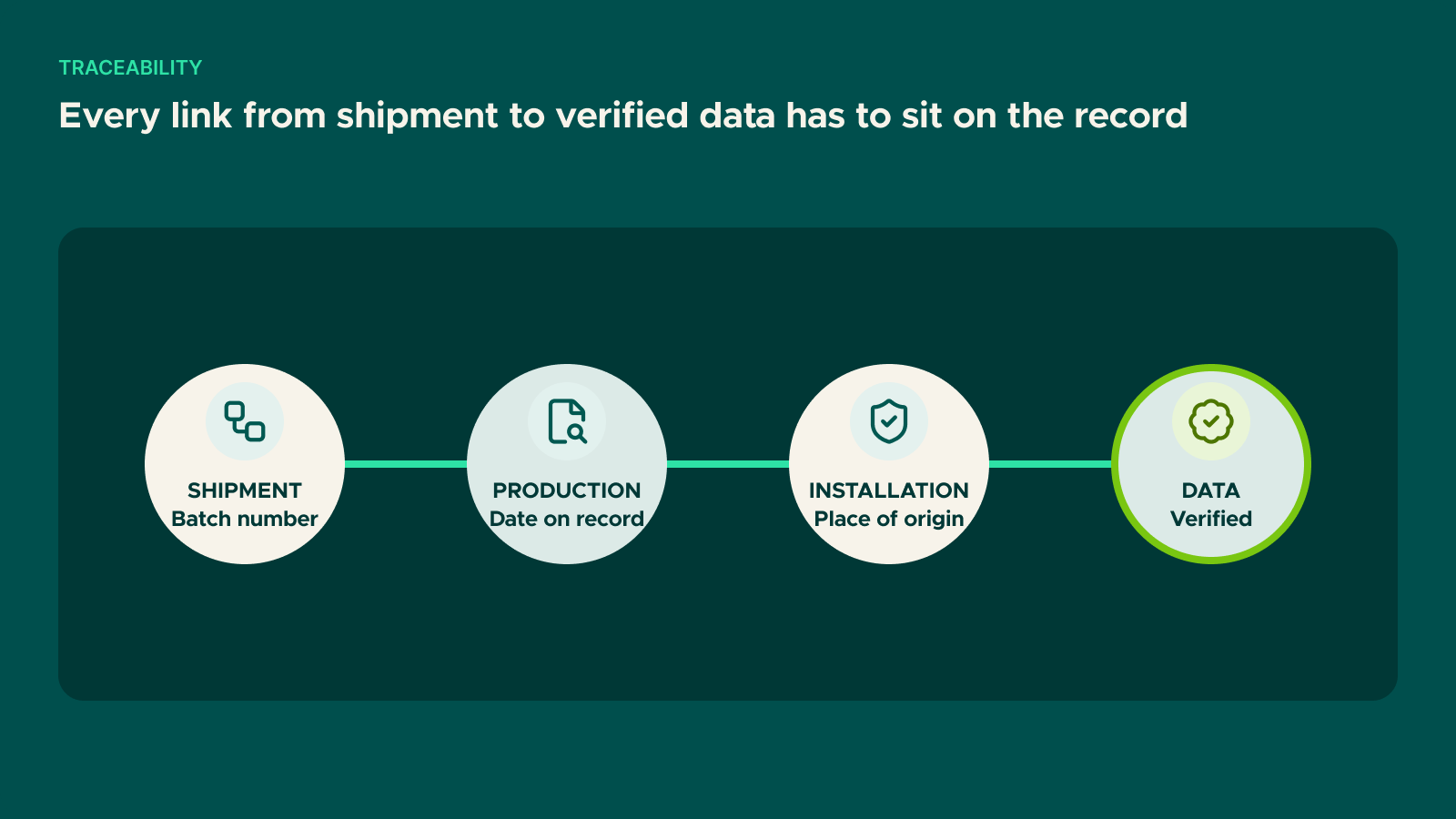
The chain to establish runs: shipment → batch or lot number → production record → installation and date of production → the verified emissions data for that period. Having each link on record is what turns a request for additional evidence into a routine answer.
Building that chain also protects a legitimate advantage. Demonstrating that goods were made in a low-emission installation is only possible where the installation-to-product match can be evidenced.
The downstream extension and the anti-circumvention measures are two halves of the same proposal. The logic runs: the narrower the scope, the easier it is to avoid cost by stepping just outside it. Extending scope to 180 downstream goods closes that gap, and the anti-circumvention measures close what remains. We cover the extension in the CBAM downstream extension, and registration in the CBAM Registry and O3CI portal.
Not where genuine production activity takes place. What matters is whether the arrangement has a commercial rationale and where the emissions actually arise.
The proposal foresees designating high-risk product and origin combinations, so a risk-based application rather than a general obligation is envisaged.
It is not mandatory today. Conditioning actual-data use on registration is at proposal stage and will be settled when the legislative process concludes.
Sanctions apply to the importer. Where the misstatement originates in the producer's data, it has consequences through the commercial relationship and contractual liability — see CBAM penalties and enforcement.
We work on establishing product-to-installation traceability and making emissions data documentable, under our CBAM accounting and reporting service. You can contact us with your questions.
Get in touch
If something you've read here connects to a live project, a reporting deadline, or a decision you're weighing — we're happy to have a useful conversation.
Contact us
Regulation & Compliance
Regulation & Compliance
Regulation & Compliance
Lets talk about your sustainability goals.