Blog
Publish: 18 Nov 26Reading Time: 7 Min
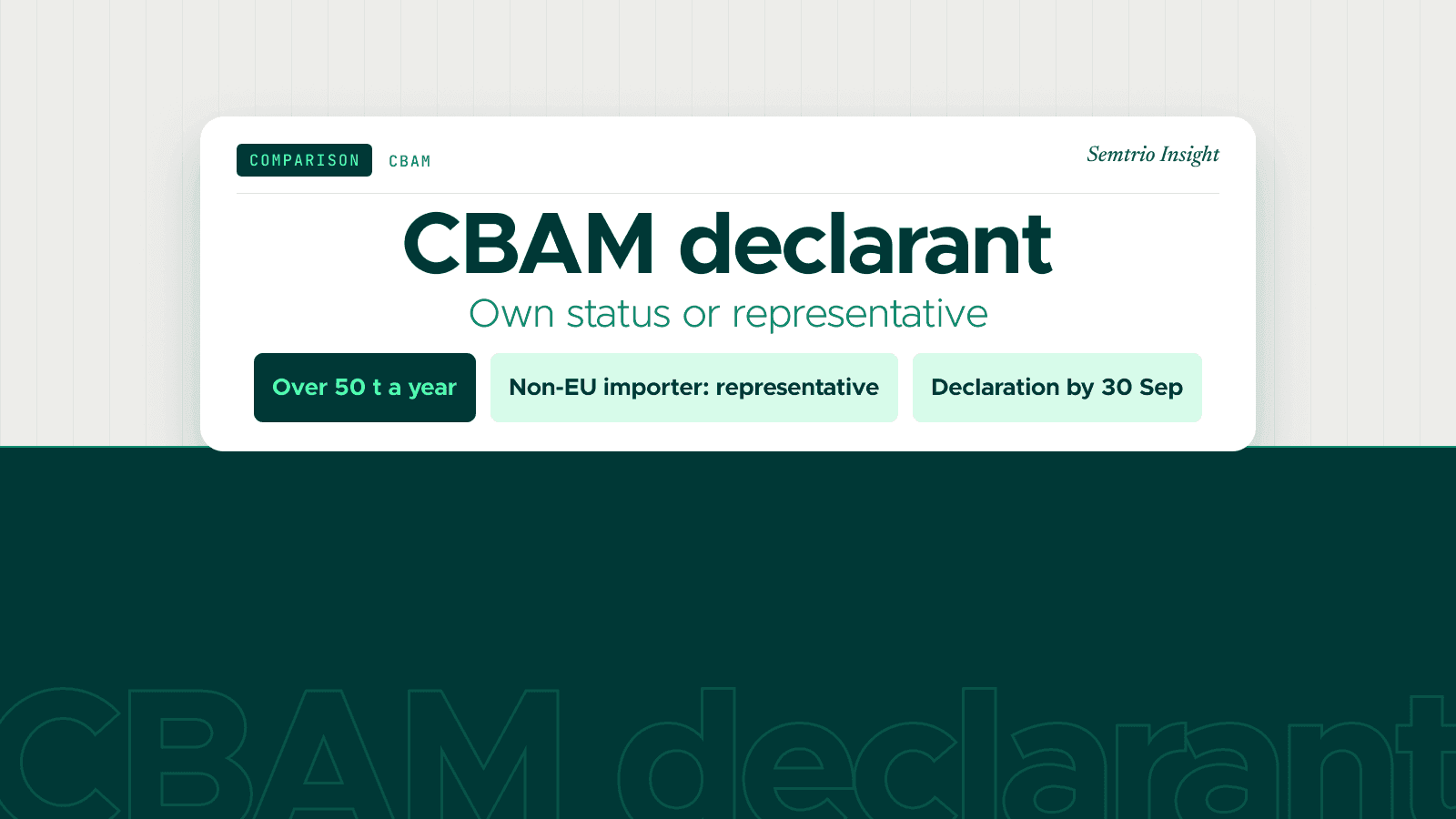
For EU imports of CBAM goods above 50 tonnes a year, the authorised CBAM declarant can only be the importer itself, if it is established in an EU Member State, or an indirect customs representative that holds the status and agrees to act for it. An importer that is not established in the EU has no choice: its indirect customs representative must hold the status. Where the representative acts as declarant, it takes on the importer's declaration, certificate and penalty obligations for the goods it imports; a service provider that only files the declaration on your behalf does not.
Last checked: 18 November 2026, against Regulation (EU) 2023/956 as amended by Regulation (EU) 2025/2083.
The 2025 simplification regulation rewrote the rules on who holds the role. Three set-ups are possible, and they differ in who carries the obligation.
| Set-up | Who holds the status | Who is liable under CBAM | Legal basis |
|---|---|---|---|
| You import in your own name | You, as importer established in a Member State | You | Art. 5(1), Art. 3(15) |
| An indirect customs representative imports on your behalf and agrees to act as declarant | The representative | The representative, for the goods it imports for you | Art. 5(1a), 5(2a) |
| You hold the status but a third party submits the declaration | You | You; the third party only files | Art. 5(7a) |
Two consequences follow from the text.
Our guide to the 50-tonne threshold covers how the threshold is counted and the 31 March 2026 transitional window; this post picks up the choice of route.
The representative steps into your CBAM position for the goods it brings in. Article 5(2a) makes it subject to the obligations that apply to the importer, and the recitals of Regulation (EU) 2025/2083 spell out that, in case of non-compliance, the representative is the one penalised. It is not penalised where it acts for an EU-established importer and has not agreed to act as declarant.
Four points matter in practice:
You apply through the CBAM Registry's authorisation module to the competent authority of the Member State where you are established, before you expect to exceed the threshold. The criteria, as set out in the Regulation and in national competent authority guidance, are:
The guarantee. If your company was not established throughout the two financial years before the year of application, the authority must require a guarantee. Its amount is the value of the certificates you would have to surrender on the import volumes you estimated in the application, for the current and following year, adjusted for EU ETS free allocation. It has to be a first-demand bank guarantee from a financial institution operating in the EU, or an equivalent form of assurance, and it is released after 30 September of the second year in which you have surrendered certificates. For a newly created EU import entity, this is often the deciding cost.
Timing. Ireland's competent authority, for example, states that the legislation gives it 120 days to assess an application, or 180 days where additional information is required.
The choice turns on volume, structure and how much of the CBAM process you want to run in-house.
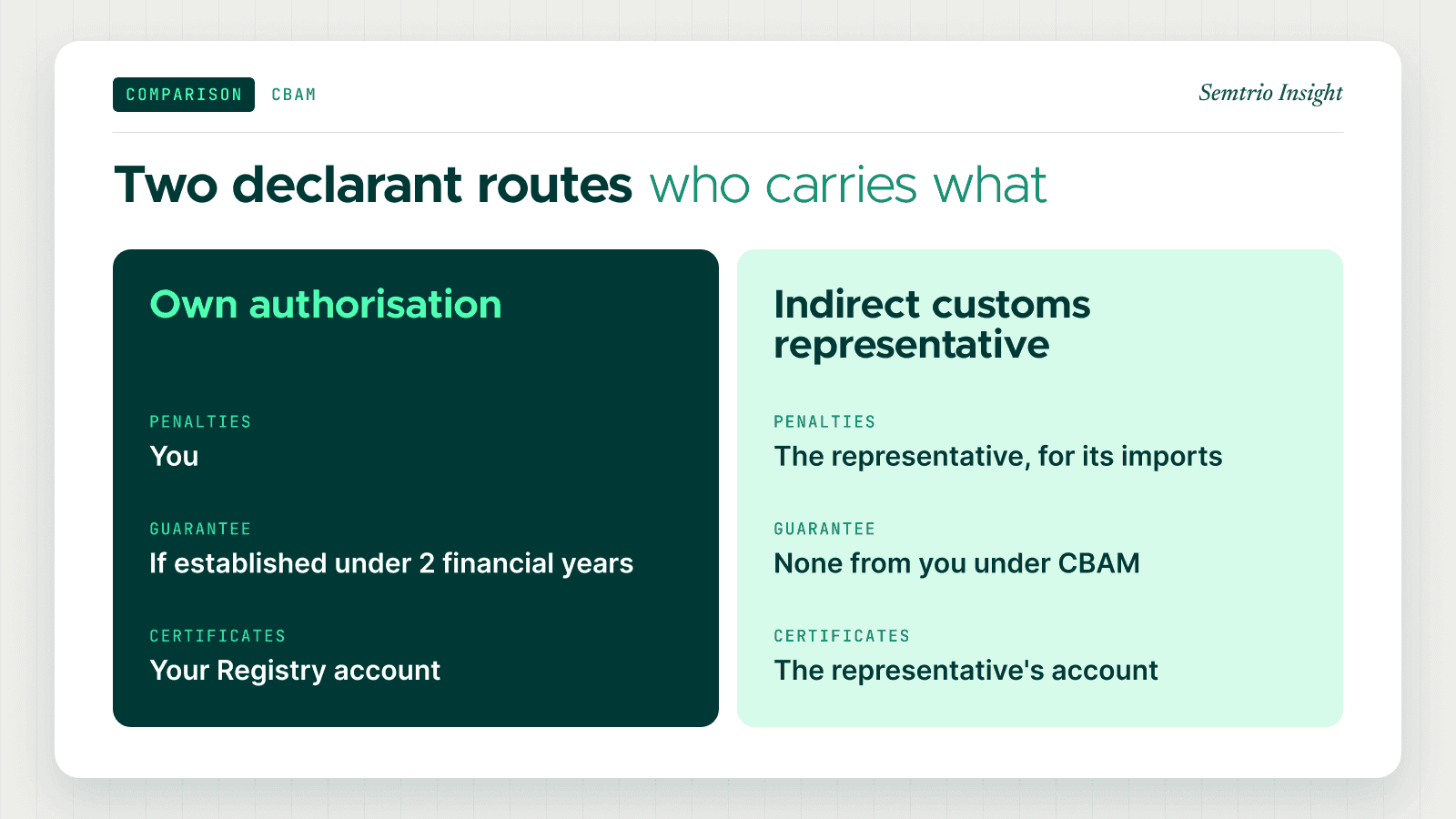
| Factor | Own authorisation | Indirect customs representative |
|---|---|---|
| Who carries CBAM penalties | You | The representative, for the goods it imports |
| Guarantee | Required if you were not established for the two prior financial years | None from you under CBAM, as long as the representative acts as declarant for all your imports; its own authorisation may need one |
| Control of declaration and certificates | Full: your Registry account, your purchases | Indirect: through the contract |
| Fits when | Volumes are recurring and well above 50 tonnes, or a group imports through several EU entities | You are not established in the EU, import occasionally, or your customs flows already run through one representative |
Work through it in this order:
On that last point, the Regulation already contains a lever. Where a declarant surrenders too few certificates because an operator, a verifier or a carbon-price certifier supplied incorrect information, the competent authority may reduce the penalty. That makes the quality of supplier data a contract question for both routes. Our post on CBAM penalties and enforcement covers the penalty levels.
The route decides who files. It does not decide the number on the declaration, which comes from installation-level data. At Tosyalı Holding, one of Türkiye's largest industrial groups, a consistent CBAM process ran across nearly twenty production entities, with embedded emissions quantified from production-level data and a submission package prepared for each site.
Across our CBAM work: every submission deadline met in the transitional period. Past results, not a guarantee.
No. The status is granted to importers established in a Member State. Where the importer is not established in the EU, its indirect customs representative must hold the status.
Yes. An authorised declarant may delegate the submission of declarations to a person acting in its name. The authorised declarant remains responsible for compliance, including the certificates and any penalty.
Yes. A representative must obtain the status before importing CBAM goods, whether or not the importer it represents is exempt. Below the threshold, you as importer declare the exemption in the customs declaration.
Each representative acting as authorised declarant declares the goods it imported for you in the year you exceeded the threshold, and surrenders the matching certificates. The threshold itself is assessed on your total imports.
The authorised declarant: you, or the indirect customs representative acting for you. Where the shortfall follows from incorrect information supplied by an operator, verifier or carbon-price certifier, the competent authority may reduce the penalty.
Related reading: Authorised CBAM declarant and the 50-tonne threshold · Collecting CBAM data from non-EU suppliers · CBAM penalties and enforcement
Before you appoint a representative or apply, map your CBAM exposure: a per-entity tonnage estimate against the 50-tonne threshold, the guarantee you would need and the supplier data each route depends on. CBAM accounting and reporting starts with that scope document.
Get in touch
If something you've read here connects to a live project, a reporting deadline, or a decision you're weighing — we're happy to have a useful conversation.
Contact usLets talk about your sustainability goals.