Blog
Publish: 18 Nov 26Reading Time: 7 Min
Since 1 January 2026, CBAM reporting means one annual CBAM declaration per authorised CBAM declarant, submitted in the CBAM Registry by 30 September of the following year, so 30 September 2027 for goods imported in 2026. That declaration rests on the installation operator's emissions report and, where actual emissions are declared, a report from an accredited verifier. The quarterly CBAM reports of the transitional period ended with 2025; from 2027 the quarter-end matters again only as a certificate-holding check.
Three parties produce CBAM reporting, but only one of them files anything with the EU.
What disappeared is the quarterly CBAM report. Under the transitional period (October 2023 to December 2025), importers reported embedded emissions every quarter, within one month of the quarter's end, with no financial obligation. That obligation does not continue in 2026. What else changed between the two periods is set out in a separate post.
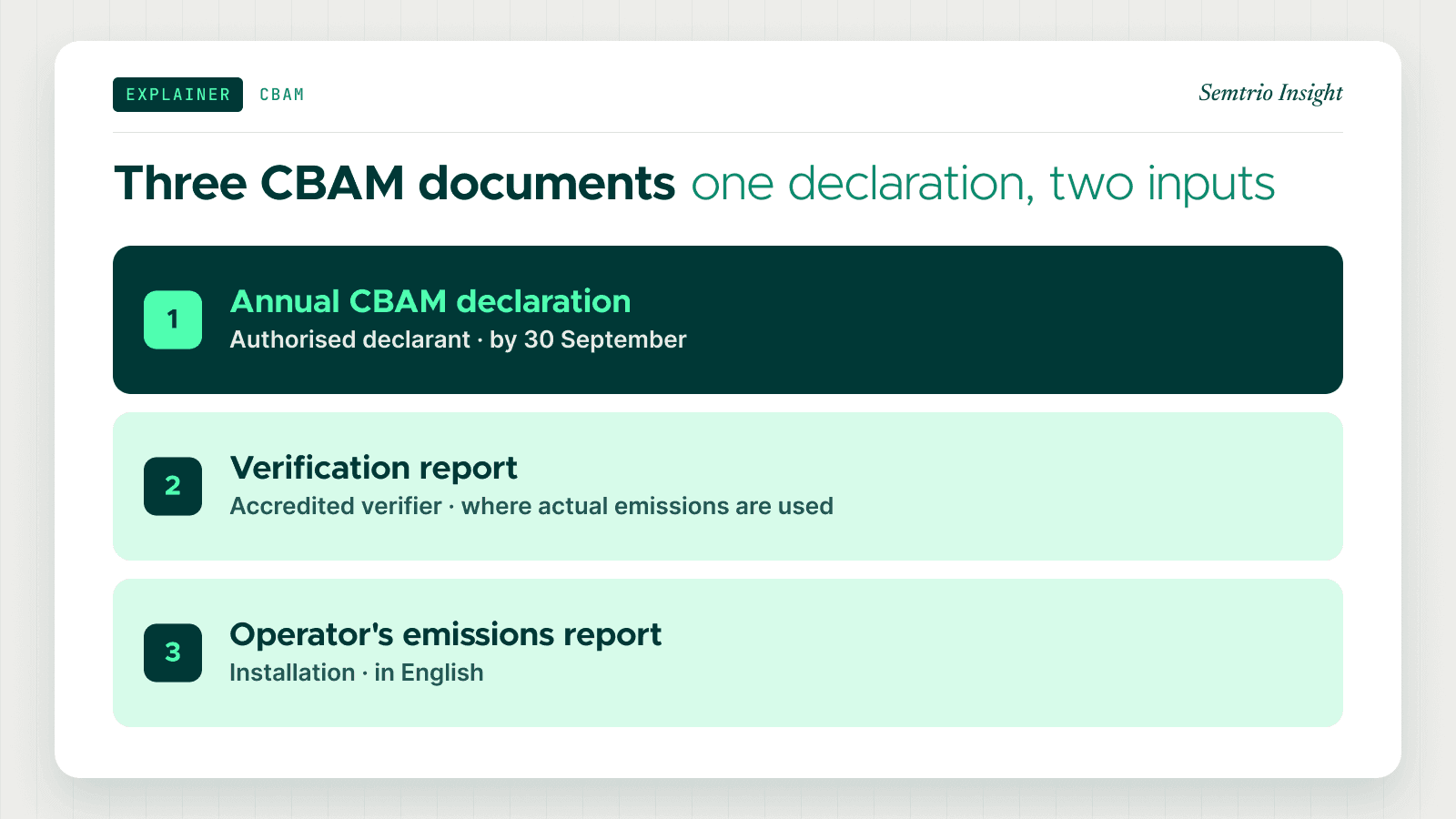
| Document | Prepared by | Sent to | What it contains |
|---|---|---|---|
| Annual CBAM declaration (Regulation (EU) 2023/956, Art. 6) | Authorised CBAM declarant | National competent authority, via the CBAM Registry | Total quantity of each type of goods imported in the previous year (tonnes; MWh for electricity), including goods below the 50-tonne threshold · total embedded emissions in t CO2e · number of CBAM certificates to surrender, after the deduction for carbon price paid abroad and the free allocation adjustment · copies of verification reports, where applicable |
| Operator's emissions report and summary (Implementing Regulation (EU) 2025/2547, Art. 10 and Annex IV) | Operator of the installation that produced the goods | The verifier, through the CBAM Registry or by other means | Identification of operator and installation · summary of the installation's monitoring plan, with its production processes and routes · total direct emissions · electricity consumed and its sources · quantities produced per production process · precursors used. Written in English |
| Verification report (Regulation (EU) 2023/956, Art. 8; Implementing Regulation (EU) 2025/2546) | Accredited CBAM verifier | Operator; the declarant attaches it to the declaration | Opinion on whether the operator's emissions report is free from material misstatement |
Two practical points follow from this table.
First, the declaration only accepts actual emissions that have been verified. Where no verified data exists for a good, the declarant must use the default values in Implementing Regulation (EU) 2025/2621, increased by a mark-up of 10% in 2026, 20% in 2027 and 30% from 2028 (1% for fertilisers). Default values need no verification, but they are set so that embedded emissions are not underestimated.
Second, the Commission's Excel template for the operator's emissions report is recommended, not compulsory. Its "Summary_Communication" worksheet holds the information the declarant needs, which is why EU buyers often ask suppliers for it. What the buyer's data request should cover is set out in CBAM supplier data: what your EU buyer needs.
The 2026 cycle is the first one, and every date below comes from the CBAM Regulation as amended by Regulation (EU) 2025/2083, or from the Commission's CBAM Q&A.
| When | What happens | Who |
|---|---|---|
| Throughout 2026 | Installation monitors and records emissions for reporting year 2026. The reporting period cannot be any period before 2026 | Operator |
| From around September 2026 | First CBAM accreditations of verifiers by national accreditation bodies | Accreditation bodies |
| Early 2027 (Commission's aim) | Verification of the 2026 operator's emissions report; a physical site visit is required in the first year, except in serious, extraordinary and unforeseeable circumstances | Operator and verifier |
| From 1 February 2027 | CBAM certificates go on sale on the common central platform, including those covering 2026 imports | Declarant |
| End of each quarter, from 2027 | Certificates on account must cover at least 50% of the embedded emissions in goods imported since the start of the year | Declarant |
| By 30 September 2027 | Annual CBAM declaration for 2026 submitted and certificates surrendered | Declarant |
| By 31 October 2027 | Request to repurchase excess certificates, within the limits of Article 23 | Declarant |
| 1 November 2027 | Certificates bought for 2026 emissions that remain on account are cancelled without compensation | Commission |
From then on the cycle repeats: the declaration for year n is due by 30 September of year n+1. How to plan the declaration backwards from 30 September, and what tends to go wrong, is covered in the annual CBAM declaration: content and deadline.
For an installation outside the EU, "reporting under CBAM" means producing a verified operator's emissions report that your customers can use. Implementing Regulation (EU) 2025/2547 sets the method.
Default values with a mark-up are the fallback when this chain breaks. For goods imported in 2026, the reporting period is fixed at 2026 even if the goods were produced earlier, so data from 2025 cannot replace 2026 data.
The work that decides a declarant's CBAM cost happens at the installation, long before 30 September. In our CBAM work with Tosyalı Holding, around 20 production entities ran one consistent compliance process: the same scoping, the same calculation from production-level data, and the same internal review before figures reached each facility team. During the transitional period, our CBAM work met 100% of quarterly submission deadlines. The definitive period moves that discipline from four quarterly reports to one verified dataset per installation per year.
No. Quarterly CBAM reports belonged to the transitional period, which ended on 31 December 2025. From 2026 the declarant submits one annual declaration; from 2027 it must also hold certificates covering at least 50% of year-to-date embedded emissions at each quarter end.
Not a declaration. The exporter's installation prepares the operator's emissions report and has it verified, so its EU customer can declare actual emissions. Registering the installation in the CBAM Registry lets it send the report to its verifier through the Registry.
No. The Commission recommends it but does not require it. Its "Summary_Communication" sheet contains the information the declarant needs, so using it reduces back-and-forth with buyers.
No. For goods imported in 2026, the reporting period is legally set to 2026, and no reporting period before 2026 is accepted. Without verified 2026 data, the declarant must use default values with the mark-up.
An importer whose CBAM goods stay at or below 50 tonnes of net mass in a calendar year is exempt and declares the exemption in the customs declaration. Once the threshold is exceeded in a year, all obligations apply to all goods imported that year. Electricity and hydrogen importers are never exempt.
Liability sits with the authorised declarant, and the national competent authority may impose penalties. Penalties are set out in Article 26 of the CBAM Regulation.
In a scoping call, we map which of your installations and CN codes need an operator's emissions report for 2026 and what the verifier will ask to see: CBAM accounting and reporting.
Get in touch
If something you've read here connects to a live project, a reporting deadline, or a decision you're weighing — we're happy to have a useful conversation.
Contact usLets talk about your sustainability goals.