Blog
Publish: 16 Nov 26Reading Time: 7 Min
GRI 101: Biodiversity 2024 replaces GRI 304: Biodiversity 2016 and is effective for reports or other materials published on or after 1 January 2026. If biodiversity is a material topic, an organisation reporting in accordance with the GRI Standards reports the GRI 101 disclosures (101-1 to 101-8) that are relevant to its biodiversity impacts. The biggest change is scope: the standard reaches into the supply chain, asks for the countries where the highest-impact products and services come from, and wants site data in hectares.
Last checked: 16 November 2026.
GRI 101 is the GRI Topic Standard for biodiversity, issued by the Global Sustainability Standards Board (GSSB). GRI published it on 25 January 2024, and it "updates and will replace GRI 304: Biodiversity 2016".
The effective date is tied to the publication date of your report, not your reporting period. The standard states that it is "effective for reports or other materials published on or after 1 January 2026". A 2025 sustainability report published in spring 2026 is therefore already a GRI 101 report if biodiversity is material.
It applies through the normal GRI logic. An organisation that has determined biodiversity to be a material topic reports Disclosure 3-3 in GRI 3: Material Topics 2021, plus the GRI 101 disclosures that are relevant to its biodiversity-related impacts. Reasons for omission are permitted, but each one has to be named in the GRI content index with an explanation.
If you are still deciding whether biodiversity is material, start with how to run a GRI materiality assessment. If it is, the eight disclosures below define what your report has to show.
The standard has two sections: three topic management disclosures and five impact disclosures.
| Disclosure | What you report |
|---|---|
| 101-1 Policies to halt and reverse biodiversity loss | Policies or commitments, how they are informed by the 2050 Goals and 2030 Targets of the Kunming-Montreal Global Biodiversity Framework, whether they cover business relationships, and goals with base year and indicators |
| 101-2 Management of biodiversity impacts | How you apply the mitigation hierarchy: avoid, minimise, restore and rehabilitate, offset, plus transformative actions; hectares under restoration per site; goals and location of each offset |
| 101-3 Access and benefit-sharing | How you comply with access and benefit-sharing rules on genetic resources; relevant for sectors such as cosmetics, pharmaceuticals and agriculture |
| 101-4 Identification of biodiversity impacts | How you determined which sites, and which products and services in your supply chain, have the most significant impacts |
| 101-5 Locations with biodiversity impacts | Location and size in hectares of those sites, proximity to ecologically sensitive areas, and the countries or jurisdictions behind the highest-impact supply-chain products |
| 101-6 Direct drivers of biodiversity loss | Per site and per supply-chain product: land and sea use change, exploitation of natural resources, pollution and invasive alien species |
| 101-7 Changes to the state of biodiversity | Ecosystem type, size and condition for the base year, and condition in the current period |
| 101-8 Ecosystem services | Ecosystem services and beneficiaries affected at each site, and how |
GRI summarises the change in four headings: full transparency throughout the supply chain, location-specific reporting on impacts, new disclosures on the direct drivers of biodiversity loss, and requirements for reporting impacts on society. In practice, three of them change your data collection.
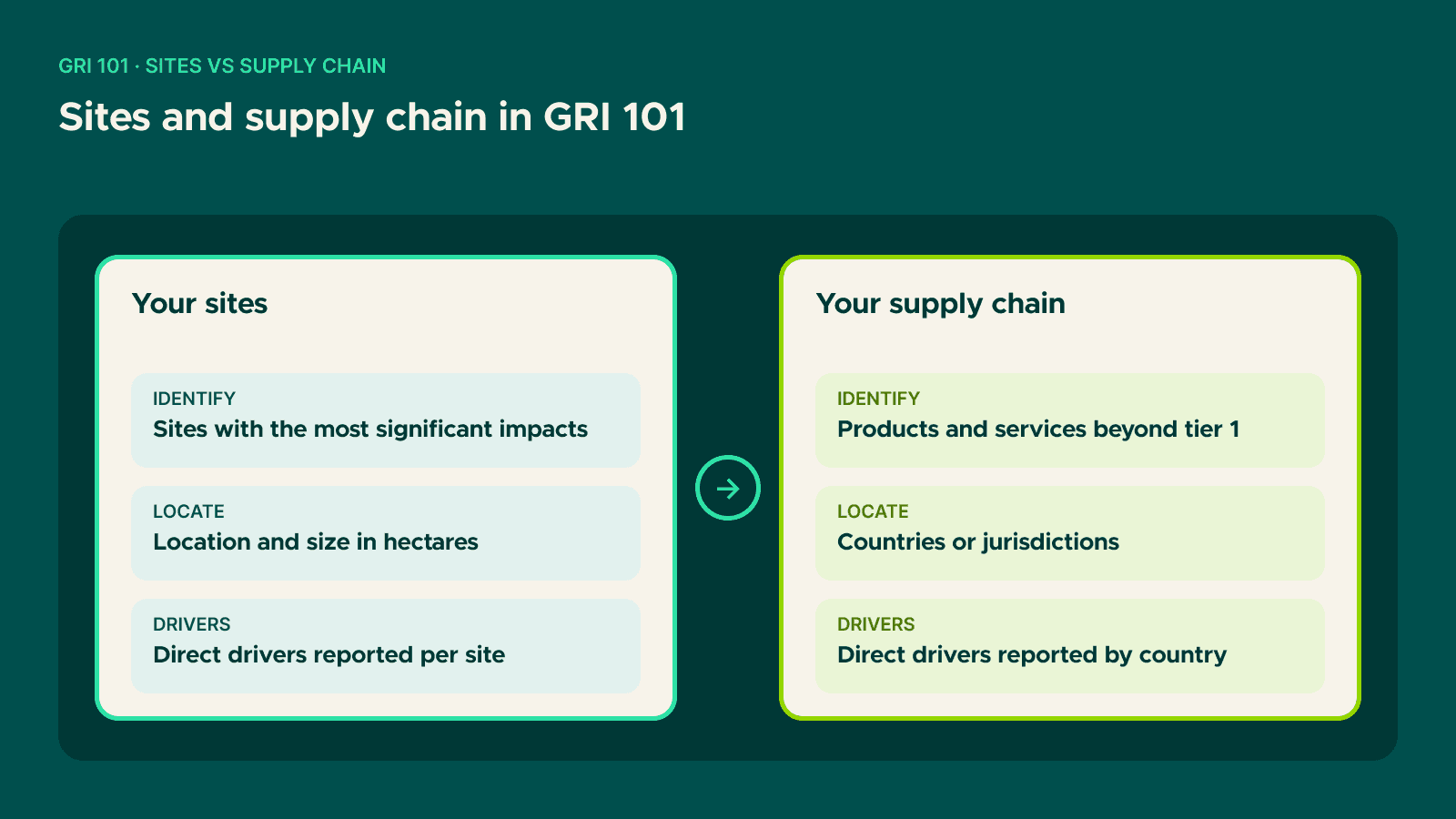
Disclosure 101-4 covers "products and services from suppliers throughout the organization's supply chain, including from suppliers beyond the first tier." Under 101-5-d you report the highest-impact products and services and the countries or jurisdictions where the related activities take place. Under 101-6-e you report the driver data for those products with a breakdown by country or jurisdiction.
The standard leaves the threshold for "most significant" to you, but it expects you to describe the methods and assumptions you used. A defensible screening method is the first deliverable, before any number is collected.
For each site with the most significant impacts, you report its location and size in hectares (101-5-a) and whether it is in or near an ecologically sensitive area, with the distance. The criteria for those areas follow the TNFD guidance, so the TNFD's Locate step and GRI 101 can share one site screening.
Land conversion is measured from a cut-off or reference date that you choose and disclose. The standard cites sector or regional cut-off dates as options, such as the 2008 date of the Brazil Soy Moratorium. For 101-7 you need the ecosystem type, size and condition in a base year, then the condition in the current period.
You report only the drivers relevant to each site: pollution for a site that pollutes, resource exploitation for a site that withdraws water or harvests wild species. Climate change is one of the five direct drivers, but the standard points you to your existing emissions disclosures for the GHG data. That link matters in 2027, when GRI 102: Climate Change and GRI 103: Energy take effect from 1 January 2027.
GRI 101 is a Topic Standard. Your sector may also have a Sector Standard that lists biodiversity as a likely material topic; check which GRI Sector Standards are published in 2026.
The hardest GRI 101 data is rarely ecological. It is the purchase ledger: which commodities come from which countries, in what volume, through how many tiers. Companies that already run a TNFD LEAP assessment have most of the site screening done; GRI and TNFD published a joint interoperability mapping in July 2024 to connect the two.
Semtrio is a GRI Community member and a TNFD Forum member, and its reporting team includes GRI-certified consultants. Through our GRI reporting work and TNFD advisory, one site and sourcing map feeds both the GRI 101 disclosures and the TNFD nature disclosures.
GRI 101 is effective for reports or other materials published on or after 1 January 2026. The trigger is the publication date, so a report covering 2025 that is published in 2026 falls under GRI 101.
Yes. GRI 101: Biodiversity 2024 updates and replaces GRI 304: Biodiversity 2016. Content indexes for reports published from 1 January 2026 should cite GRI 101 disclosure numbers.
Only if biodiversity is a material topic, and then the disclosures relevant to your biodiversity-related impacts. Reasons for omission are permitted, but each must be stated in the GRI content index with an explanation.
Yes, for the products and services in your supply chain with the most significant biodiversity impacts, including beyond first-tier suppliers. You report the countries or jurisdictions where those activities take place and the related driver data by country.
GRI 101 uses TNFD guidance to define ecologically sensitive areas and refers to the TNFD LEAP approach. GRI and TNFD published a joint interoperability mapping in July 2024, so one site screening can serve both.
Related reading: How are the GRI Standards structured? · GRI Sector Standards in 2026 · GRI 102 and GRI 103
For a report published in 2026 or 2027, GRI reporting advisory starts with a GRI 101 gap list: each of the eight disclosures marked as reportable, needs data, or reason for omission, with the site and sourcing data each one needs.
Get in touch
If something you've read here connects to a live project, a reporting deadline, or a decision you're weighing — we're happy to have a useful conversation.
Contact usLets talk about your sustainability goals.


