Blog
Publish: 02 Sep 26Reading Time: 5 Min
Choosing a GRI reporting advisor comes down to four things: verifiable GRI credentials and engagement, demonstrated materiality assessment experience, content index and disclosure-mapping competence, and fluency across the other frameworks — IFRS S1/S2, ESRS/CSRD, CDP — that most reporting programs now touch. Getting this choice right shapes the credibility of every report cycle that follows.
A GRI report is only as credible as the process behind it. A materiality assessment with undocumented reasoning, or a content index citing superseded Standard numbers, is visible to any informed reader, investor, or assurance provider. The advisor's job is to prevent these gaps — which means the advisor's own fluency with the current Standards matters directly to the client's reporting credibility, not just to internal process efficiency.
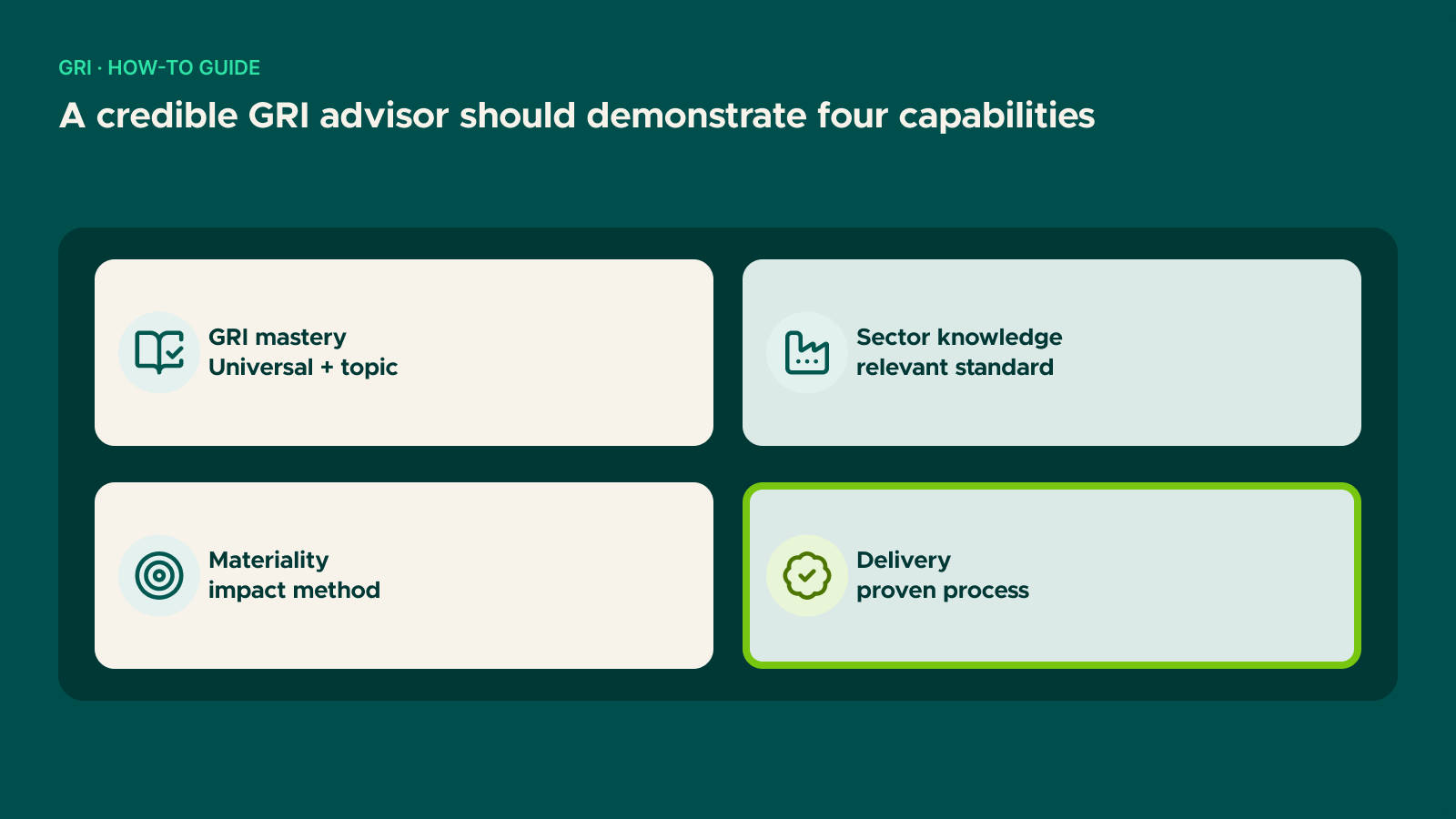
GRI Community Membership or equivalent standing engagement with GRI. This signals ongoing, direct engagement with GRI's standard-setting process, rather than occasional or historical familiarity with the Standards.
Demonstrated materiality assessment experience. Ask for specifics on how a prospective advisor has run the GRI 3 process for other clients — how they identify and evidence impacts, how they document stakeholder engagement, and how they set prioritization thresholds. Vague answers here are a warning sign, since this is the step most prone to producing a defensible or indefensible report depending on rigor. See How to Conduct a GRI Materiality Assessment for what a rigorous process actually involves.
Content index and disclosure-mapping competence. An advisor should be able to speak precisely about current Standard versions — for example, correctly distinguishing the 2025 GRI 102 (Climate Change) and GRI 103 (Energy) from the legacy GRI 305 and GRI 302 standards they superseded. An advisor still citing outdated numbering is not current with the Standards they are advising on. See How to Build a GRI Content Index: A Step-by-Step Guide for the level of technical precision this work requires.
Sector-specific fluency where applicable. If your organization operates in oil and gas, coal, agriculture/aquaculture/fishing, or mining, the advisor should be conversant with the relevant Sector Standard (GRI 11, 12, 13, or 14). If your sector does not yet have a published Standard, the advisor should be tracking GRI's Sector Program roadmap — including standards in development for banking, insurance, capital markets, and textiles/apparel/footwear — so your next reporting cycle is not caught off guard by a new publication. See Is Your Industry Covered by a GRI Sector Standard? (2026 Update).
Very few reporting programs today run GRI in isolation. An advisor who understands GRI but cannot speak accurately to how it relates to IFRS S1/S2, ESRS/CSRD, and CDP will leave a reporting team to make framework-sequencing decisions unsupported. The distinctions matter in practice: GRI's voluntary, impact-materiality, stakeholder-inclusive approach differs from IFRS S1/S2's mandatory-where-adopted, financial-materiality, investor-facing approach (see GRI vs IFRS S1/S2); from ESRS/CSRD's mandatory, double-materiality approach (see GRI vs ESRS/CSRD); and from CDP's narrower, investor-facing rating system for climate, water, and forests (see GRI vs CDP). A capable advisor should be able to explain, specifically for your organization, which frameworks are mandatory, which are voluntary, and how the underlying data collection can serve more than one framework without duplication.
Some organizations run GRI reporting entirely in-house, particularly once a first cycle has established process and templates. External advisors tend to add the most value at three specific points: the initial materiality assessment (where an outside perspective and structured stakeholder engagement process reduce internal bias), the content index build (where precision on current Standard versions matters most), and any cycle where the organization is layering GRI against a newly mandatory framework like ESRS.
Semtrio Note: Semtrio has been a GRI Community Member since 2020, and its sustainability reporting services are built directly around the three areas covered in this article: materiality assessment, content index preparation, and reporting process design.
If you are evaluating advisors for your next GRI reporting cycle, our sustainability reporting team is available to talk through scope, process, and how GRI fits alongside any other frameworks your organization already reports under.
GRI's membership categories (such as Community Membership) reflect organizational engagement with GRI, not a formal accreditation of advisory quality. Buyers should still evaluate an advisor's demonstrated materiality assessment and content index experience directly.
Not necessarily the same advisor for every framework, but the GRI advisor should at minimum understand how these frameworks relate to GRI so your data collection and reporting calendar are coordinated rather than duplicated across separate, disconnected engagements.
This varies significantly by organization size, data maturity, and whether a Sector Standard applies, so any advisor should scope a specific timeline for your organization rather than quoting a generic figure.
Imprecision about current Standard versions — for example, an advisor unaware that GRI 102 (Climate Change) and GRI 103 (Energy) are 2025 standards superseding the legacy GRI 305 and GRI 302 — suggests the advisor is not current with the Standards they are being hired to apply.
Get in touch
If something you've read here connects to a live project, a reporting deadline, or a decision you're weighing — we're happy to have a useful conversation.
Contact us
Regulation & Compliance
Regulation & Compliance

Regulation & Compliance
Lets talk about your sustainability goals.